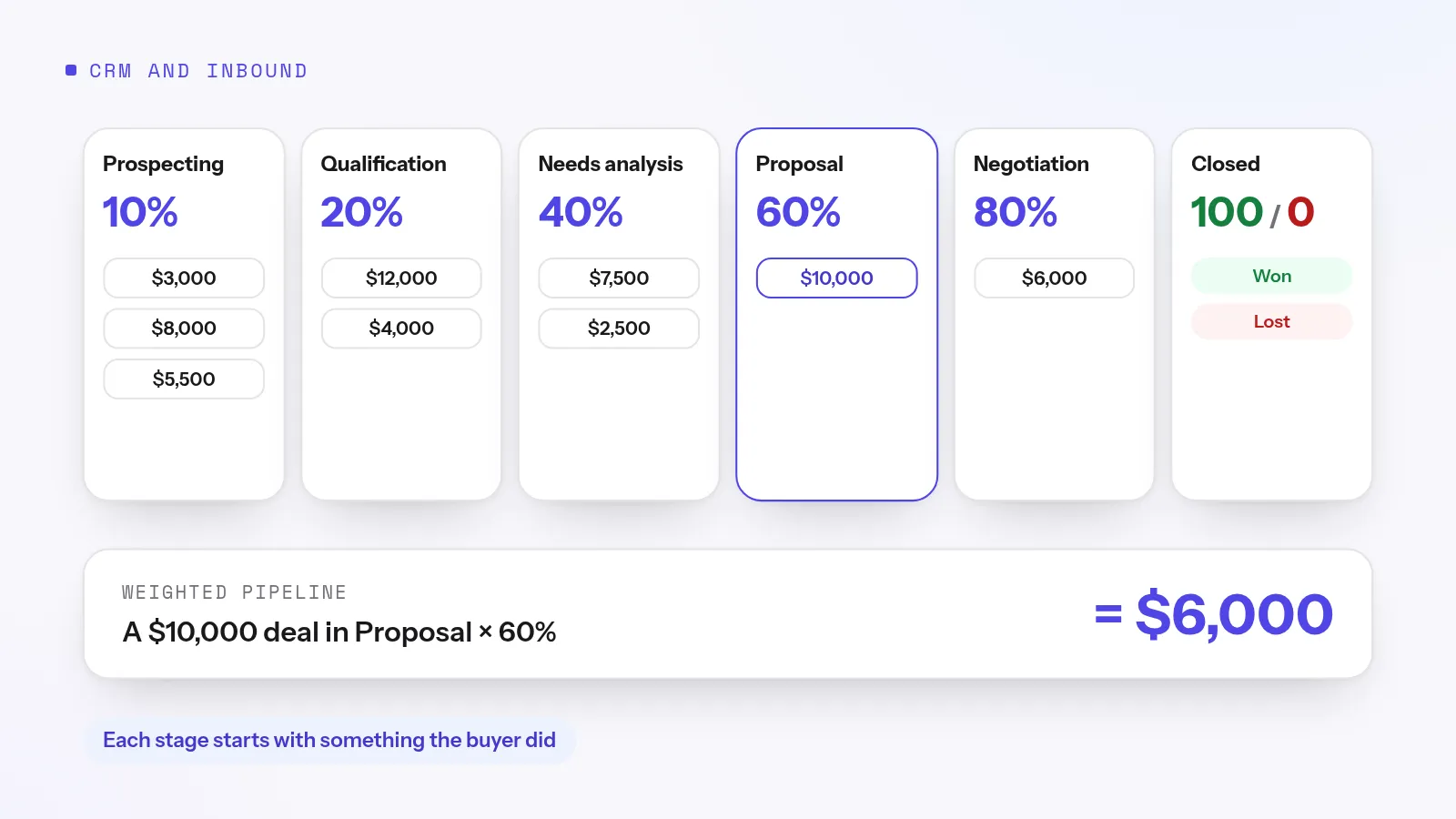
A sales pipeline is the set of stages a deal moves through, from first real conversation to closed won or closed lost. Most small teams need five or six open stages, each defined by something the buyer did, not something the rep felt. Give every stage a win probability and the pipeline doubles as a rough forecast.
A real conversation has happened and there's a possible need
10%
Qualification
Budget, timing and decision maker are known
20%
Needs analysis
You understand the problem well enough to propose
40%
Proposal
A price or quote has been sent
60%
Negotiation
The buyer is discussing terms, not whether to buy
80%
Closed won / lost
Signed, or a clear no
100% / 0%
Define stages by what the buyer did
"Proposal" should mean a proposal was sent, not that the rep plans to send one. Exit criteria based on the buyer's actions make the pipeline honest: a deal can't sit in Negotiation because the rep has a good feeling. Write the rule for each stage in one sentence and keep it where the team can see it.
Deal stages vs lead stages
Lead stages track a person before there's a deal: new, contacted, qualified. Deal stages track the opportunity once it exists. Mixing them makes both lists long and vague. We cover the lead side in lead stages, and how to decide which leads deserve a deal in lead scoring for small sales teams.
Build a pipeline with your own stages and win odds, and see who moved every deal. The CRM comes with every seat.
If every stage carries a win probability, multiplying each deal's amount by its stage's odds and adding them up gives a weighted pipeline. A $10,000 deal in Proposal at 60% counts as $6,000. It's rough, but far better than adding up every open deal at full value. Check your odds against what actually closes every quarter, and adjust.
Common pipeline mistakes
Too many stages. If reps can't explain the difference between two stages, merge them.
Deals that never die. A deal with no activity for weeks is lost in all but name. Close it with a reason.
No lost reasons. "Price", "timing", "went with a competitor": tracked over time, these tell you what to fix.
One pipeline for every motion. New business and renewals close differently. Give each its own pipeline.
Pipeline stages in Adoptiv
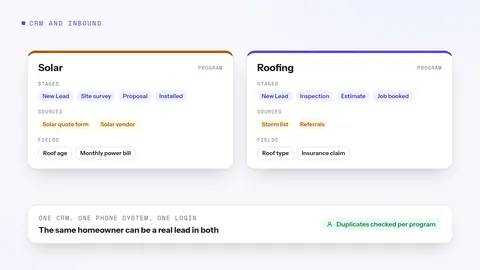
Adoptiv starts every workspace with a seven-stage deal pipeline, from Prospecting at 10% to Negotiation at 80%, then Closed Won and Closed Lost. You can't add or remove stages in that starter pipeline, but you can build as many pipelines as you need, each with its own stages and a win probability from 0 to 100 on each. Every stage change is recorded with who made it, won and lost deals carry a reason, and each deal can be assigned to one owner. People on a deal can be tagged with a role, such as decision maker, influencer, champion or blocker, with one marked primary. Deals sit beside the lead stages that come before them.
Common questions
How many stages should a sales pipeline have?+
Five or six open stages suits most small teams, plus closed won and closed lost.
What is a weighted pipeline?+
The sum of each open deal's amount multiplied by its stage's win probability. It's a quick, rough forecast.
Should I have more than one pipeline?+
Yes, if you sell in clearly different ways, such as new business and renewals, or two products with different sales cycles.
Why track lost reasons?+
Because patterns in why deals are lost tell you what to change: pricing, targeting, timing or the product itself.
Adoptiv is the dialer, the CRM and the AI on one platform, where the busywork logs itself and your reps just talk. Try it free for 14 days, with no credit card.
Questions? Call +1 (844) 955-7733. SIYA answers and puts you through to a person.