Lead scoring gives each lead a number so reps know who to call first. A small team needs two kinds of points: fit (does this lead look like your customers?) and engagement (have they answered, replied or asked for something lately?). Keep it to six to ten rules, take points away as activity goes stale, and pick one score above which a lead gets a call today. Check it against closed deals every month.
Big companies build scoring models with dozens of inputs and a data team to tune them. A team of five reps doesn't need that. It needs a short list that answers one question every morning: who do we call first? This post is part of our guide to a CRM with a built-in phone system.
Fit and engagement: the two halves
Fit is about who the lead is. Are they in your area, your industry, the right size, the right job title? Fit changes rarely, so you score it once and revisit only when the record changes.
Engagement is about what the lead has done. Did they answer a call, reply to a text, open the quote you sent, ask for a callback? Engagement is what tells you a lead is warm right now, and it should fade if nothing happens for a few weeks.
A lead with high fit and no engagement belongs in a nurture sequence. A lead with high engagement and poor fit is worth one honest qualifying call. The leads you want at the top of the list score well on both.
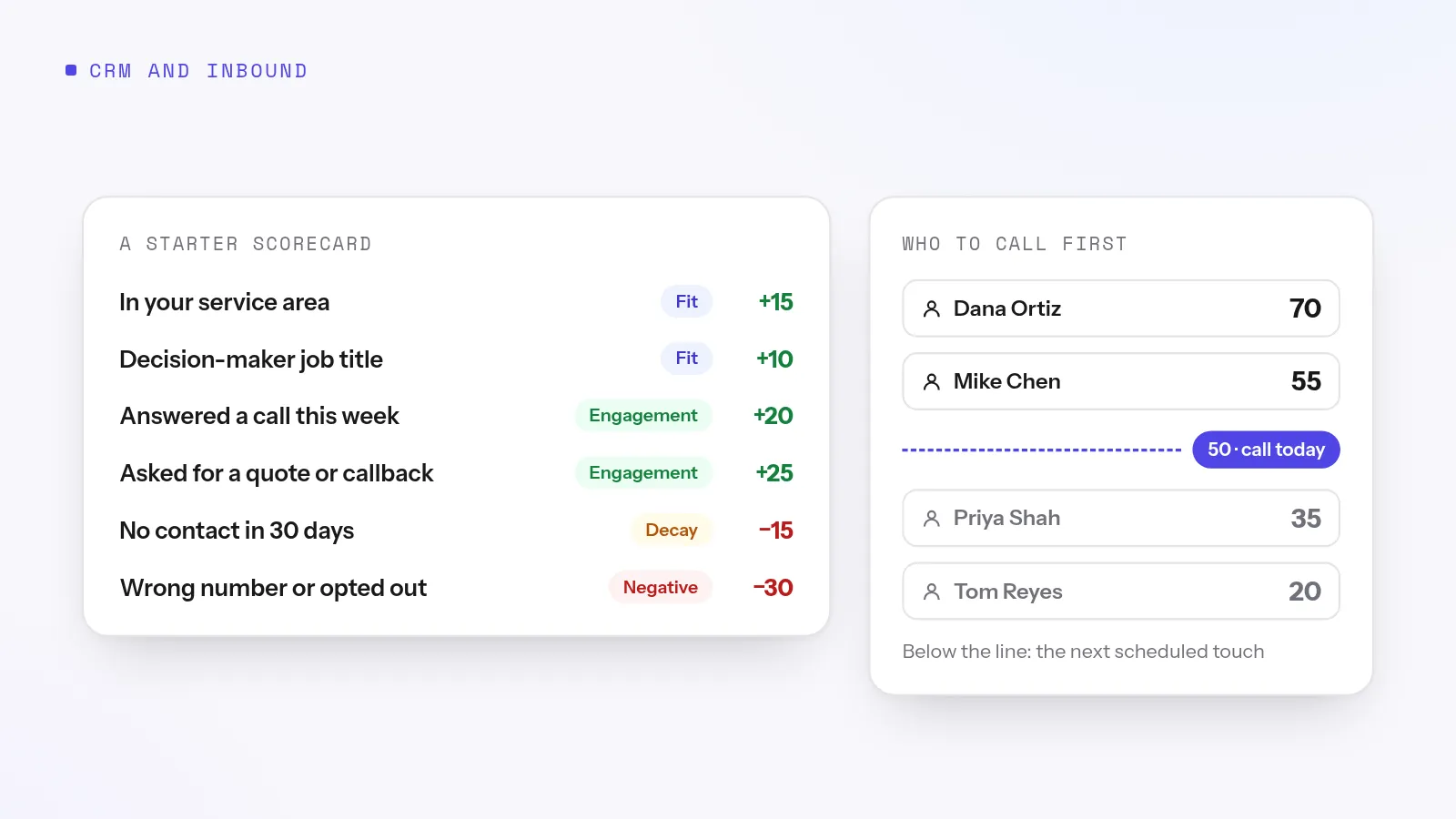
A starter scorecard
Signal
Type
Points
In your service area or target market
Fit
+15
Decision-maker job title
Fit
+10
Came from your best-converting lead source
Fit
+10
Answered a call in the last 7 days
Engagement
+20
Replied to a text or email in the last 7 days
Engagement
+15
Asked for a quote, demo or callback
Engagement
+25
No contact of any kind in 30 days
Decay
−15
Bounced email, wrong number or opted out
Negative
−30
The exact numbers matter less than the order they produce. If your "call today" list keeps surfacing people who never buy, change the weights. Knowing which lead sources actually close is the quickest way to set the fit points honestly.
Try it on your own numbers. Every lead carries a score your reps can sort by, beside every call they've had.
Scores only help if they change what reps do. Pick one line, say 50, and make the rule simple: anything above it gets a call today, and anything below it waits for its next scheduled touch. A second line for "send to nurture" is optional. More bands than that and nobody remembers what they mean.
Scores and stages do different jobs. A stage says where a deal stands in your process. A score says how likely a lead is to talk to you this week. Keep both, and see how to set up lead stages if yours have drifted.
Mistakes that make scores useless
Too many rules. Past about ten, nobody can explain why a lead is a 62, and reps stop trusting the number.
No decay. A lead who opened one email in March shouldn't still outrank someone who called yesterday.
Scoring what you can't see. If calls aren't logged to the lead, your engagement points are guesses.
Never checking. Once a month, pull last month's closed deals and see what they scored before they bought. If winners were scoring low, your weights are wrong.
Where Adoptiv fits
In Adoptiv every lead carries a score, a whole number your reps can sort and filter on, so the morning list can start with the highest-scored leads. Calls, voicemails and texts land on the lead's history by themselves, so engagement isn't something reps have to type in. Filter for leads above your threshold, save that list as one of your saved views, and it's there every morning.
One limit to know: the scoring rules are Adoptiv's own, the same for every workspace, so you can't write your own weights in the app. If your team wants a custom model like the scorecard above, keep it in a custom field alongside the built-in score.
Common questions
How many rules should a lead scoring model have?+
For a small team, six to ten. Enough to separate good fits from poor ones and warm leads from cold, few enough that any rep can explain a score.
What's the difference between fit and engagement scoring?+
Fit scores who the lead is, such as location, industry and job title. Engagement scores what they've done recently, such as answering calls or replying to messages.
Should lead scores go down over time?+
Yes. Take points away when a lead goes quiet for a few weeks, or old activity keeps stale leads at the top of the list.
How often should we review our lead scoring?+
Monthly. Compare what last month's won deals scored before they closed, and adjust the weights if the winners were scoring low.
Adoptiv is the dialer, the CRM and the AI on one platform, where the busywork logs itself and your reps just talk. Try it free for 14 days, with no credit card.
Questions? Call +1 (844) 955-7733. SIYA answers and puts you through to a person.