Skip to content
Adoptiv

Cold call objection handling: 12 responses that work

Adoptiv Team3 min read

Short answer

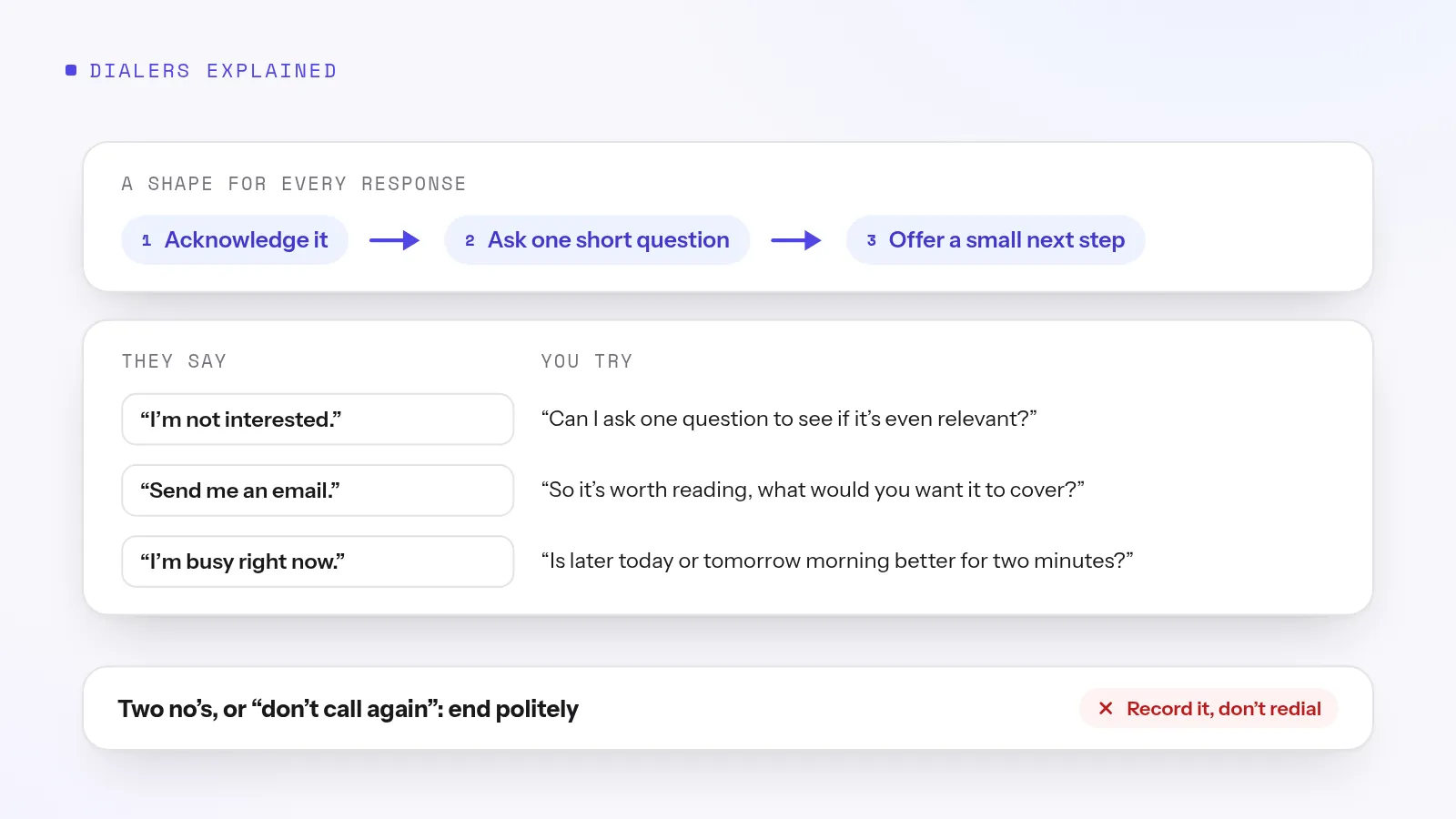
Most cold call objections are a reflex, not a final no. Acknowledge what the person said, ask one short question that earns the next 30 seconds, and offer a small next step. If they say no twice, or ask not to be called again, end politely and record it.

A three-step shape for answering cold call objections, acknowledge, ask one short question, offer a small next step, with responses to not interested, send me an email and busy right now, and a reminder to stop after two no's.
On this page
  1. A simple shape for every response
  2. 12 common objections and a response to each
  3. How to practice objections
  4. Practicing objections with Adoptiv

Objections are the moment a cold call is decided. A rep who answers "not interested" with a calm question gets a conversation; a rep who argues gets a hang-up. This post is part of our outbound dialer guide.

A simple shape for every response

  1. Acknowledge. Repeat the objection in a few words, so they know you heard it.
  2. Ask. One question that's easy to answer and tells you whether there's a fit.
  3. Offer a small step. Two minutes now, a short call later, or one piece of information.

Keep it short. A response longer than two sentences turns into a pitch, and the person stops listening.

12 common objections and a response to each

Objection

What it usually means

A response to try

"I'm not interested."

A reflex; they don't know what you offer yet

"Fair enough, most people say that before I explain. Can I ask one question to see if it's even relevant?"

"Send me an email."

A polite exit

"Happy to. So it's worth reading, what would you want it to cover?"

"I'm busy right now."

Bad timing, or a polite exit

"Understood. Is later today or tomorrow morning better for two minutes?"

"We already have a provider."

They're not in pain, yet

"Good to hear. What would you change about it if you could?"

"How did you get my number?"

Suspicion

Answer honestly and briefly, then: "If it's not a good time, I can let you go."

"It's too expensive."

Price is unclear or value isn't

"What are you comparing it to? I'd like to make sure we're comparing the same thing."

"We don't have the budget."

Not now, or not a priority

"When does your budget usually get set? I can follow up then."

"I need to talk to my partner."

Shared decision

"Makes sense. What will they want to know? I can send that ahead of the call."

"Just call me next quarter."

A real or soft deferral

"I'll do that. What's likely to change by then?"

"We tried something like this."

A bad past experience

"What happened? I'd rather know now than repeat it."

"I'm not the right person."

Wrong contact

"Thanks for telling me. Who usually handles this?"

"Take me off your list."

A clear request to stop

"Of course. I'll make sure you're not called again." Then mark it, and don't argue.

The last one isn't an objection to handle. It's a request to honor, and it may carry legal weight under Do Not Call rules. This is general information, not legal advice, so check with your own counsel.
Try it on your own numbers. Hear how your reps handle objections: listen, whisper or barge on live calls, and review recordings kept for a year.

Start Free Trial

How to practice objections

  • Write your team's top five. Pull them from real calls, not a generic list, and agree one response each.
  • Role-play in pairs. Five minutes a day is enough to make the responses sound natural instead of read.
  • Review real calls weekly. Pick a call where an objection went well and one where it didn't, and listen to both together. Our sales call coaching guide has a method.
  • Track outcomes, not just dials. A rep who dials less but turns more objections into conversations is doing better. See our post on cold calls per hour for why raw dial counts mislead.

Practicing objections with Adoptiv

Call recordings are kept for a year, so you can build your team's objection list from real calls. From the live calls board, an admin, or anyone with the "Supervise calls" permission for the reps on their teams, can listen, whisper or barge on a live call. The customer never hears a whisper, so a manager can feed a rep the next line in the moment.

On AI+ and Dialer Plus, recorded calls on your own number above a minimum talk time get an AI call summary, which makes it quicker to find the calls where objections came up. When your workspace has call outcomes set up, the wrap-up asks the rep for one before they move on. For outbound teams, see Adoptiv for outbound calling.

Common questions

What is the most common cold call objection?

"I'm not interested" comes up on almost every list, usually before the person knows what you offer. Treat it as a reflex and ask one short question.

How do you respond to "send me an email"?

Agree, then ask what the email should cover. If they answer, you have a conversation. If they don't, the email probably wasn't going to be read.

When should a rep stop trying?

After a second clear no, or straight away when someone asks not to be called again. Record the request and end the call politely.

Should objection responses be scripted?

Agree the shape and a few key lines as a team, then let each rep say them in their own words. Read word for word, a response sounds like a script.

ShareLinkedInXEmail

About Adoptiv

Adoptiv is the dialer, the CRM and the AI on one platform, where the busywork logs itself and your reps just talk. Try it free for 14 days, with no credit card.

Questions? Call +1 (844) 955-7733. SIYA answers and puts you through to a person.

Citing this article

Adoptiv Team. “Cold call objection handling: 12 responses that work”. Adoptiv Inc, November 28, 2026. Retrieved from https://adoptiv.com/blog/cold-call-objection-handling

Have questions?

or email support@adoptiv.com

Free trial

Try It on Your Own Numbers.

Hear how your reps handle objections: listen, whisper or barge on live calls, and review recordings kept for a year.

14-day trial · no card · migration included