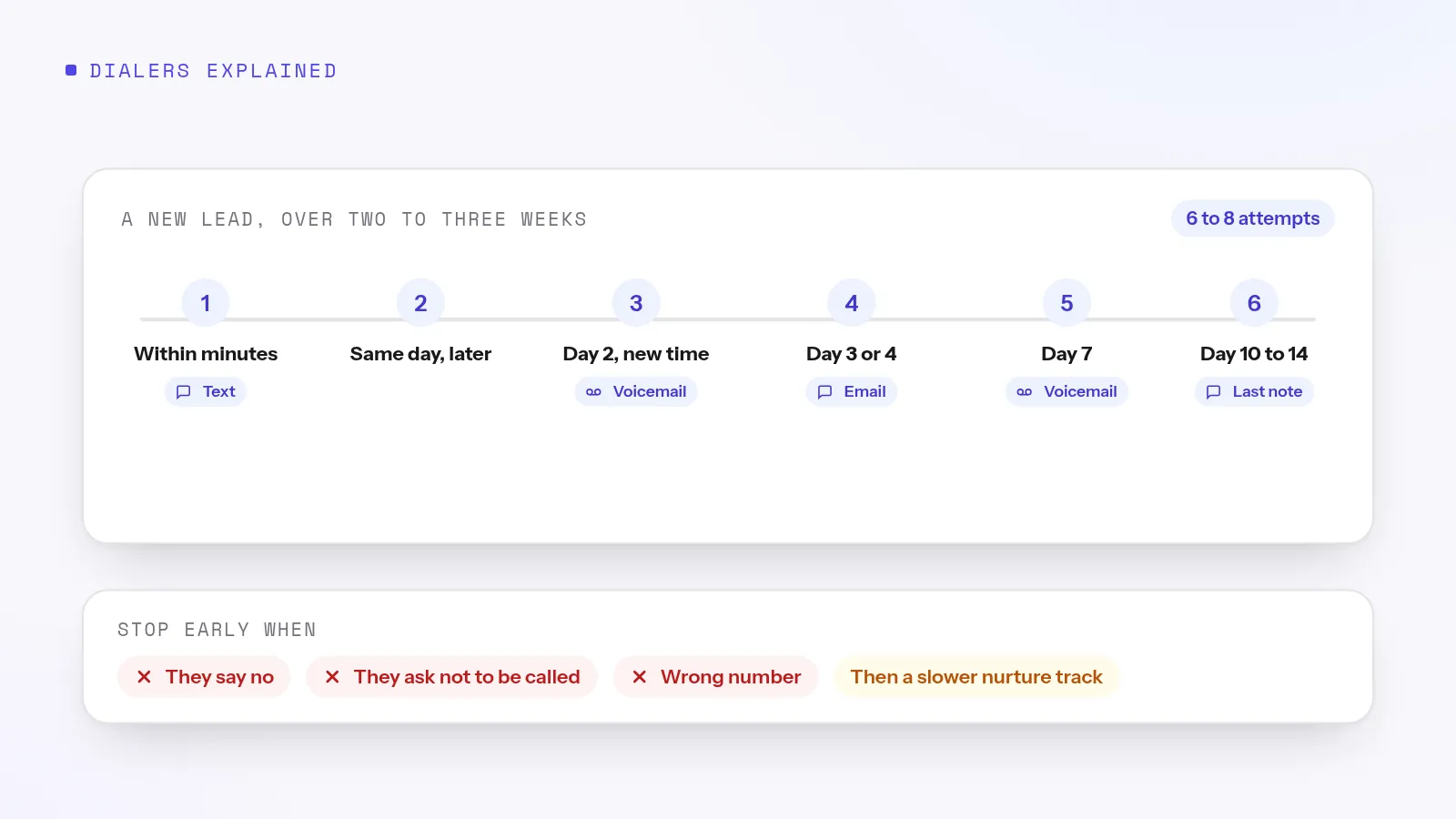
Plan for six to eight attempts over two to three weeks for a new lead, front-loaded in the first few days, at different times of day, with a voicemail or text on some of them. Stop early when the lead says no, asks not to be called, or the number is wrong. After the last attempt, move the lead to a slower nurture track rather than calling forever.
Most leads don't answer the first call. Teams that give up after one or two attempts leave most of their pipeline untouched, while teams that call ten times in two days annoy people and burn their numbers. This is part of our guide to outbound dialers.
A sample cadence for a new lead
Attempt
When
Add
1
Within minutes of the lead arriving
Text if no answer
2
Same day, a few hours later
Nothing
3
Day 2, a different time of day
Voicemail
4
Day 3 or 4
Email
5
Day 7
Voicemail
6
Day 10 to 14
A last short text or email
Inbound leads that asked to hear from you justify a faster, longer cadence than cold lists. For purchased or cold data, fewer attempts spread wider are usually enough.
Vary the time, not just the day
Calling at 10 a.m. six days running reaches the same busy person six times. Rotate between morning, lunch, late afternoon and early evening in the lead's own time zone, within the hours you're allowed to call.
Campaigns track every lead's attempts and stop at your cap. They're in early access, so ask us to turn them on.
Let the outcome decide the next step
Each call should end with an outcome, and the outcome should change what happens next. A busy signal can be retried soon; a voicemail means wait a day; "call me next week" means a dated callback; "not interested" or "don't call" means stop. Our guide to call outcomes that reorder your list shows how to set those rules up, and voicemail drop covers leaving messages without slowing reps down.
When to stop
The lead says no, or asks not to be contacted.
The number is wrong, disconnected or on a do-not-call list.
You've reached your attempt limit with no answer.
The lead has engaged elsewhere, for example by booking online.
Some states limit how many times a day you may call the same person, and federal and state do-not-call rules apply to every attempt. This is general information, not legal advice, so check with your own counsel.
Call attempts in Adoptiv
In an Adoptiv campaign, every contact keeps its attempts, last outcome and next attempt, and every lead stops at the campaign's attempt cap, six by default. Reps pick an outcome at the end of every call. Compliance screening checks numbers against the federal registry, the known-litigator list and your own do-not-call list. Every campaign skips numbers on your own do-not-call list and known litigators. By default, power and predictive campaigns also skip numbers on the federal registry or not screened in the last 30 days, while preview campaigns show those leads with a warning and ask for a reason before the call. Campaigns are in early access: preview is on every plan, and power and predictive come with Dialer Plus or Enterprise.
Common questions
How many call attempts does it take to reach a lead?+
It varies widely by list and industry, but several attempts are normal. That's why a plan of six or more attempts reaches far more people than one or two.
Is calling a lead twice in one day too much?+
For a fresh inbound lead, a second call a few hours later is common. Beyond that, spread attempts across days and check any state limits on daily calls.
Should I leave a voicemail every time?+
No. Leave one on some attempts, such as the third and fifth. A voicemail on every call starts to feel like pressure.
What should happen after the last attempt?+
Move the lead to a slower track, such as a monthly email or a check-in next quarter, rather than deleting it or calling forever.
Adoptiv is the dialer, the CRM and the AI on one platform, where the busywork logs itself and your reps just talk. Try it free for 14 days, with no credit card.
Questions? Call +1 (844) 955-7733. SIYA answers and puts you through to a person.