Call outcomes that reorder your list: callback rules that work
Adoptiv Team··2 min read
Short answer
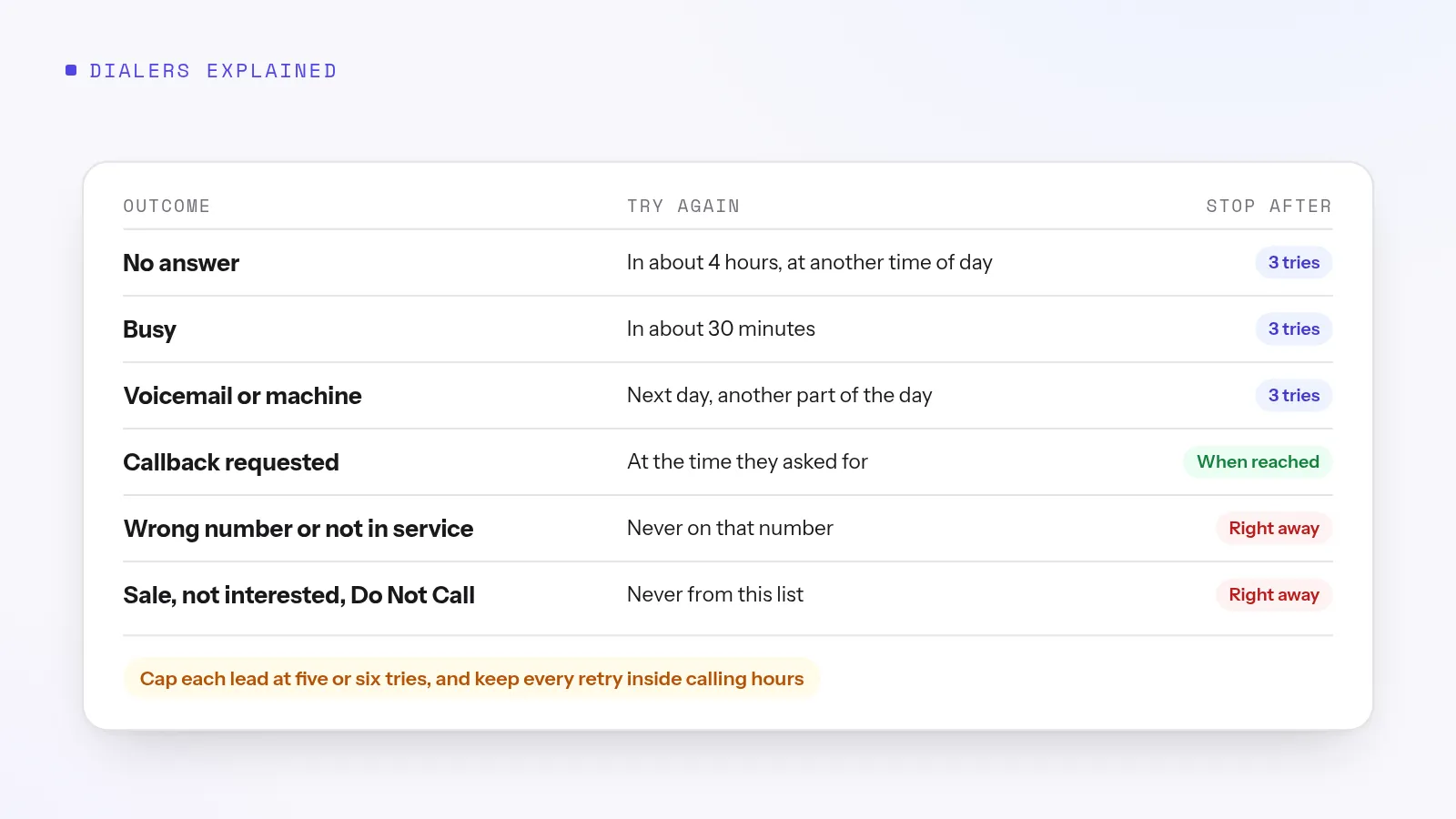
Every call outcome should answer one question: when, if ever, is this lead called again? No answer and busy get short retries spread across the day, voicemail gets a longer gap, a requested callback gets the time the person asked for, and a sale, "not interested" or Do Not Call ends the calls. Cap the total attempts per lead so nobody is called forever.
A dialer list isn't a fixed order. Outcomes push leads back, pull them forward and take them out. This post is part of our outbound dialer guide.
Why outcomes should drive the order
If every lead goes back to the end of the list whatever happened, you call the person who said "try me at 3" at 9 the next morning, and you call the busy line again in two days instead of twenty minutes. Clean outcomes are what make good rules possible; our post on call disposition codes covers choosing them.
A starting set of rules
Outcome
Try again
Stop after
No answer
In about 4 hours, at a different time of day
3 tries
Busy
In about 30 minutes
3 tries
Voicemail or machine
Next day, a different part of the day
3 tries
Callback requested
At the time they asked for
When they're reached
Wrong number or not in service
Never on that number
Right away
Sale, not interested, Do Not Call
Never from this list
Right away
These are starting points to test, not rules from any carrier or regulator.
Campaigns keep each lead's attempts and next attempt. They're in early access, so ask us to turn them on for your team.
Rules that hold up
Vary the time of day. A lead who never answers at 10 am may answer at 5 pm. Retrying at the same hour wastes attempts.
Cap attempts per lead. Five or six tries across a week or two is plenty for most cold lists.
Respect the window. A retry "4 hours later" shouldn't land at 9 pm in the lead's time zone. Keep every retry inside your calling hours.
Honor a named time. A callback someone asked for beats any automatic rule, and it should be called by the rep who spoke to them where possible.
End means end. "Not interested" and Do Not Call take the lead out, and Do Not Call should cover every list, not just this one.
Retry rules matter most when a power dialer is moving fast; at a few lines per rep, a bad rule burns through a list in an afternoon. This is general information, not legal advice, so check with your own counsel.
How it works in Adoptiv
In an Adoptiv campaign, every contact keeps its attempts, last outcome and next attempt, so a list worked slowly never loses its place; see power and preview dialing. Reps pick an outcome at the end of every call, and every lead stops at the campaign's attempt cap, six by default. Outside a campaign, an outcome doesn't book a callback or create a task by itself today, so set the follow-up on the lead. Campaigns are in early access: preview is on every plan, and power and predictive come with Dialer Plus or Enterprise.
Common questions
How many times should a dialer call one lead?+
Five or six attempts over one to two weeks is a common cap for cold lists, spread across different times of day.
How soon should I retry a busy signal?+
Busy usually means the person is on another call, so a retry in about 30 minutes often works.
Should voicemail count as an attempt?+
Yes. It used a call and reached the lead's phone, so count it toward the cap and wait longer before the next try.
What happens to a lead marked "not interested"?+
It should leave the list. Calling again after a clear no hurts your reputation and the number's.
Adoptiv is the dialer, the CRM and the AI on one platform, where the busywork logs itself and your reps just talk. Try it free for 14 days, with no credit card.
Questions? Call +1 (844) 955-7733. SIYA answers and puts you through to a person.