An AI voice agent brief tells the agent who it is, what calls it handles, what it must never do, where its facts come from and when to hand the caller to a person. Write it like a note to a new receptionist: a greeting, one clear job, a short list of house rules, a few trusted sources, and explicit handoff triggers. Then test it with real calls before it goes live.
Most AI phone agents that sound bad were given a bad brief, not a bad model. This guide walks through each part of a brief and gives you a template you can copy. It's part of our guide to AI phone calls.
The five parts of a good brief
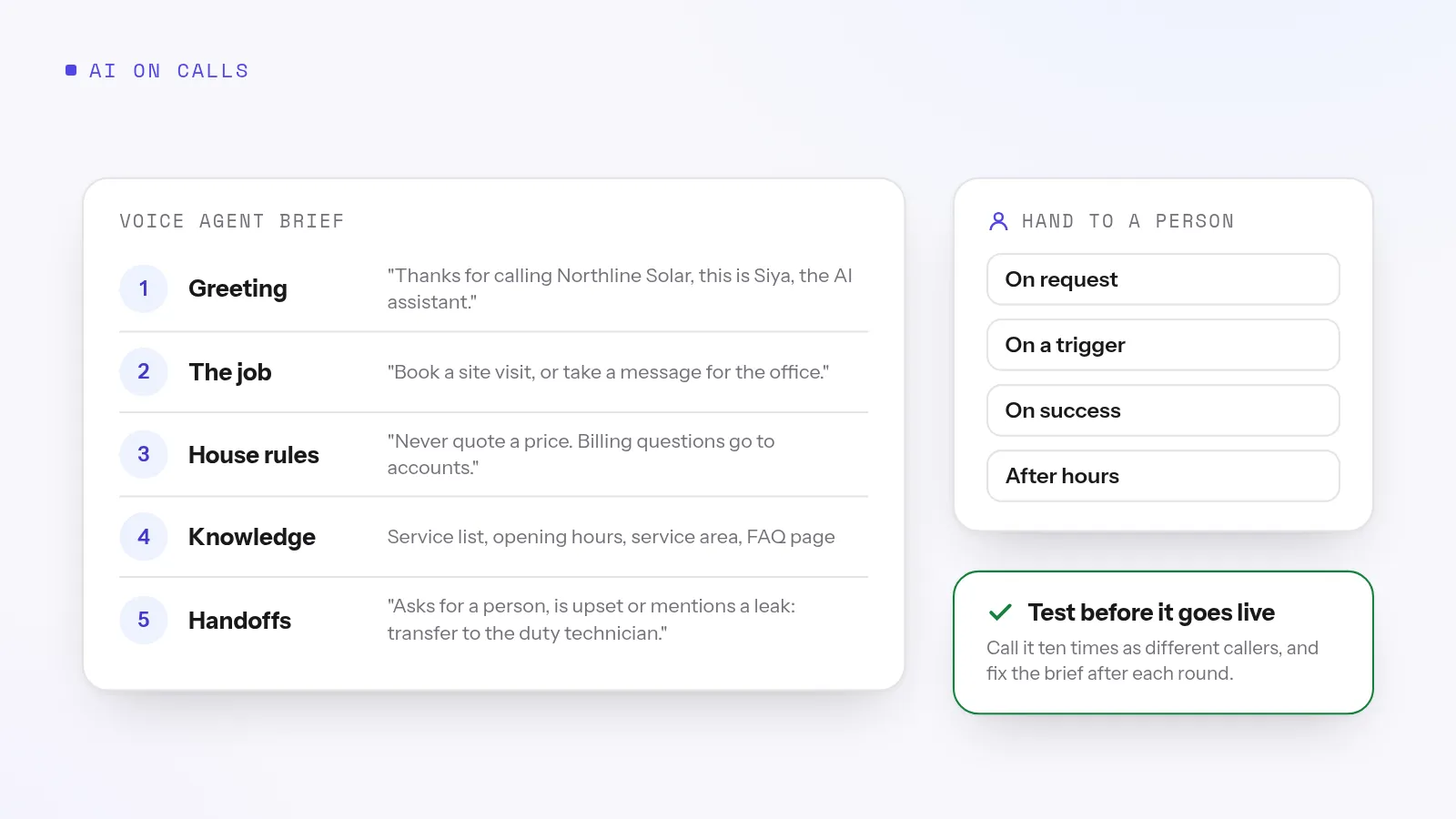
Part
What to write
Example
Greeting
The first sentence callers hear, including that they're speaking with an AI assistant if you disclose it
"Thanks for calling Northline Solar, this is Siya, the AI assistant. How can I help?"
The job
One goal, in one or two sentences
"Find out what the caller needs and book a site visit, or take a message for the office."
House rules
Short do's and don'ts, plus routing
"Never quote a price. Billing questions go to accounts."
Knowledge
The sources it may answer from
Service list, opening hours, service area, FAQ page
Handoffs
When to fetch a person, and who
"If the caller asks for a person, is upset, or mentions a leak, transfer to the duty technician."
Write one job, not ten
The commonest mistake is a brief that tries to cover every call. An agent with one goal asks better questions and ends calls sooner. If you have two very different call types, such as new customers and existing ones, route them to two agents with two briefs rather than one agent with a long list of "if this, then that". Ask for short replies, one or two sentences at a time. Anything longer is hard to follow on a phone line.
House rules: short and trusted
House rules are the lines the agent must not cross: no prices, no legal or tax opinions, no promises about dates. Keep them few. Every rule is in front of the agent on every call, so ten precise rules beat forty vague ones. Put routing here too ("billing goes to accounts"), because that's an instruction the agent should act on, not a fact to recite.
Knowledge: give it sources, not memory
Don't paste your whole website into the brief. Link the sources it may answer from, such as a services page, hours and a short FAQ, and tell it to say "I'll have someone get back to you" when the answer isn't there. An agent that admits a gap is better than one that guesses a price. Our post on AI phone answering for law firm intake shows how strict this needs to be when the stakes are high.
Try it on your own numbers. Call SIYA on +1 (844) 955-7733 to hear a brief at work, then write your own and put her in a call flow.
On request. Anyone who asks for a person gets one. Never make a caller argue with the agent.
On a trigger. Name the words or situations that mean "transfer now": an emergency, a complaint, a cancellation.
On success. A qualified caller who wants to talk to sales should reach sales, not a message.
After hours. Decide what happens when nobody can take the transfer: a message, a voicemail box or a callback promise you'll keep.
Test before it goes live
Call it yourself ten times, playing different callers: the confused one, the angry one, the one who only wants opening hours, the one who asks something the brief never covered. Fix the brief after each round. Then listen to the first real calls every day for a week. Our AI receptionist for small business guide covers what those first weeks usually show.
A brief template you can copy
Fill in the brackets, keep each line short, and cut anything that doesn't apply to your calls.
Section
Template line
Greeting
"Thanks for calling [business name], this is [agent name], the AI assistant. How can I help?"
Who you are
"You answer the phone for [business name], a [what you do] in [service area]. Speak in short, friendly sentences, one or two at a time."
The job
"Find out what the caller needs, get their name, number and [one or two details], and [book a visit / take a message / transfer to sales]."
House rules
"Never quote a price. Never promise a date or time. Don't give legal or tax opinions. [Billing questions] go to [team]."
Knowledge
"Answer only from [services page], [hours and service area] and [FAQ]. If the answer isn't there, say someone will get back to them."
Handoffs
"Transfer to [team or person] when the caller asks for a person, is upset, or mentions [emergency words]. Outside hours, take a message."
Ending
"Repeat back the name and number, say what happens next, and thank them for calling."
Writing SIYA's brief in Adoptiv
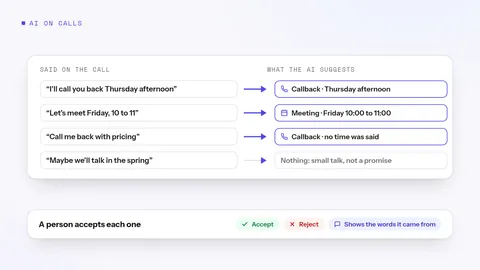
In Adoptiv, the AI voice agent is called SIYA. You choose her voice and write her greeting, and her answers come from her instructions, your house rules and the knowledge sources you link. She answers from a SIYA step in your call flow, and a Business Hours step can send closed-hours calls to her and daytime calls to your team. When a caller asks for a person, she passes the call to whoever you wired for that request. What she proposes during the call waits as a suggestion for a person to accept. To hear a brief at work, call Adoptiv's own main line, which she answers.
Rules on telling callers they're speaking with an AI, and on recording calls, vary by state. This is general information, not legal advice, so check with your own counsel.
Common questions
How long should an AI voice agent brief be?+
Short enough to read in two minutes: a greeting, a goal of one or two sentences, up to about ten house rules, a list of sources and the handoff triggers. Long briefs make agents slower and less predictable.
Should the agent say it's an AI?+
Many businesses say so in the greeting, and some places require it. Put the wording in the greeting so every call starts the same way, and check the rules that apply to your calls.
What if a caller asks something the brief doesn't cover?+
Tell the agent to admit it and offer a person or a message. Then add the question to its knowledge sources so the next caller gets an answer.
How often should I update the brief?+
Weekly at first, after listening to real calls, then whenever your prices, hours or services change. Most fixes are one line in the house rules or one new source.
Adoptiv is the dialer, the CRM and the AI on one platform, where the busywork logs itself and your reps just talk. Try it free for 14 days, with no credit card.
Questions? Call +1 (844) 955-7733. SIYA answers and puts you through to a person.