Yes, in almost every case. Saying so in the first sentence costs nothing, sets the caller's expectations, and avoids the bad moment when they find out halfway through. Some places require it for certain calls. Keep the line short and friendly, and always let a caller who wants a person reach one.
AI voice agents now sound natural enough that many callers can't tell. That makes the choice to disclose a deliberate one. This guide covers why to do it, how to word it, and what to do when callers push back. It's part of our guide to AI phone calls.
Why disclosure usually wins
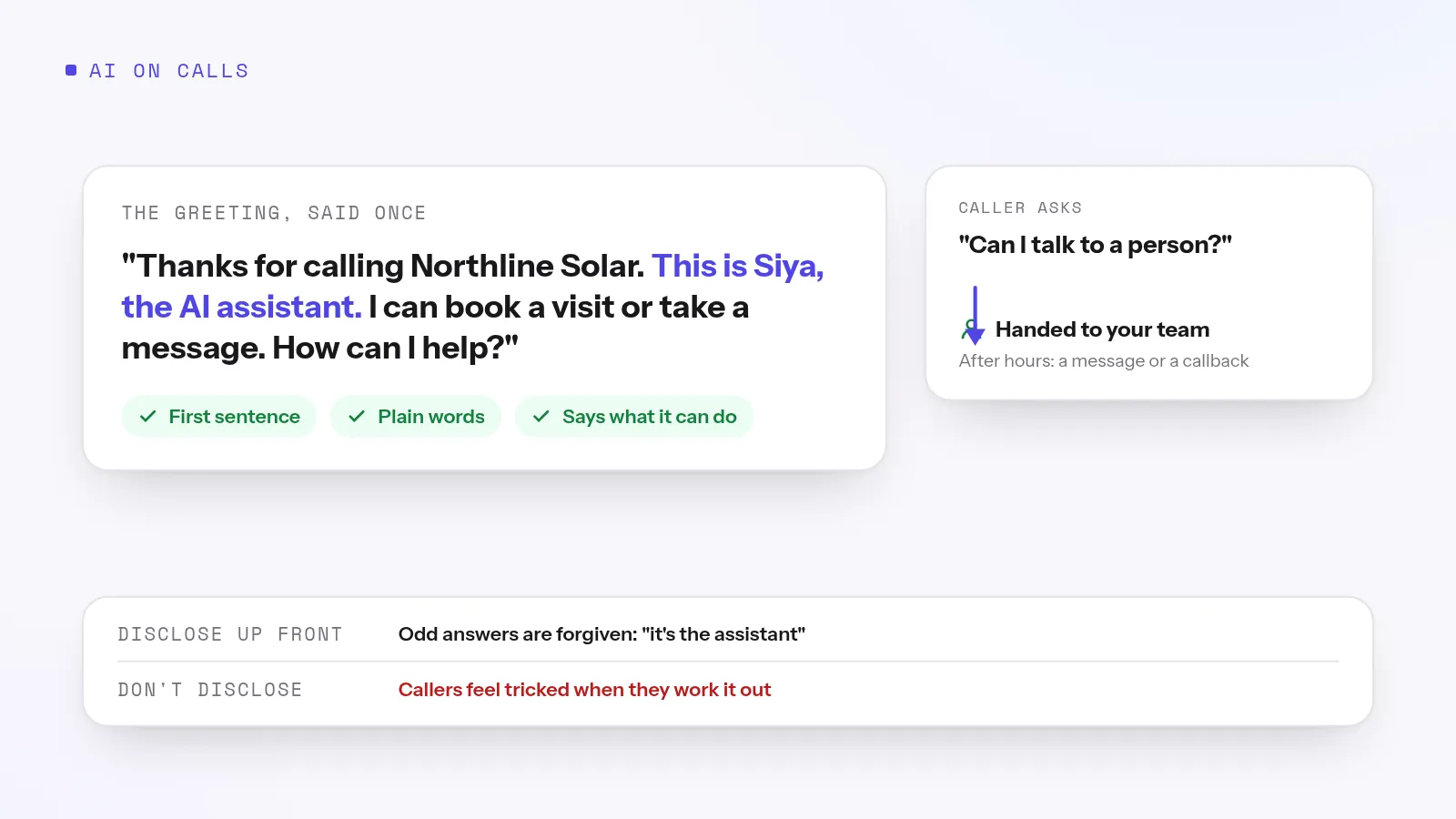
Disclose up front
Don't disclose
Caller trust
Expectations set from the first line
Feels tricked if they work it out
Odd answers
Forgiven: "it's the assistant"
Blamed on your business
Asking for a person
Natural and quick
Awkward, often angry
Rules
Meets disclosure requirements where they apply
Risky where disclosure is required
How to word it
Put it in the greeting, in plain words, once. For example: "Thanks for calling Northline Solar. This is Siya, the AI assistant. I can book a visit or take a message. How can I help?" That tells the caller what they're speaking to and what it can do in one breath. Avoid long legal-sounding statements; they make callers hang up before you've helped them. Our guide to writing an AI voice agent brief shows where the greeting fits in the rest of the instructions.
Always offer a person
Disclosure works only if the caller has a real choice. Make "can I talk to a person?" a guaranteed handoff, not something the agent argues about. After hours, offer a message or a callback you'll actually make. Some callers will always prefer a human, and that's fine; the agent's job is to help everyone else faster.
Try it on your own numbers. Call SIYA on +1 (844) 955-7733 to hear an AI greeting, then write your own and put her in a call flow.
An AI calling someone who didn't ring you is a different situation from one answering your line. Rules on automated and artificial-voice calls are stricter for outbound, especially to mobile numbers, and often require prior consent. If you're considering AI for outbound calls, get the consent side sorted first.
Measure the effect
Compare hang-ups in the first ten seconds before and after you change the greeting.
Count how often callers ask for a person, and at what point in the call.
Listen to a handful of calls each week, especially short ones.
In Adoptiv, the AI voice agent is called SIYA. You choose her voice and write her greeting, so you decide exactly how she introduces herself. She answers from a SIYA step in your call flow, and when a caller asks for a person, she passes the call to whoever you wired for that request. You can hear how she introduces herself on Adoptiv's own main line, which she answers.
Rules on telling callers they're speaking with an AI, and on recording calls, vary by state and by type of call. This is general information, not legal advice, so check with your own counsel.
Common questions
Is it legal to use an AI on phone calls without saying so?+
It depends on where you and your callers are and the type of call. Some places require disclosure, and outbound automated calls have extra consent rules. Disclosing up front avoids the question.
Does saying it's an AI make callers hang up?+
A few may, but most stay if the agent is quick and useful. A short, friendly line works far better than a long statement.
Should the AI have a human name?+
A name is fine, as long as the greeting also makes clear it's an assistant, not a person.
What if a caller asks whether they're talking to a real person?+
The agent should answer honestly and offer to connect them with someone.
Adoptiv is the dialer, the CRM and the AI on one platform, where the busywork logs itself and your reps just talk. Try it free for 14 days, with no credit card.
Questions? Call +1 (844) 955-7733. SIYA answers and puts you through to a person.