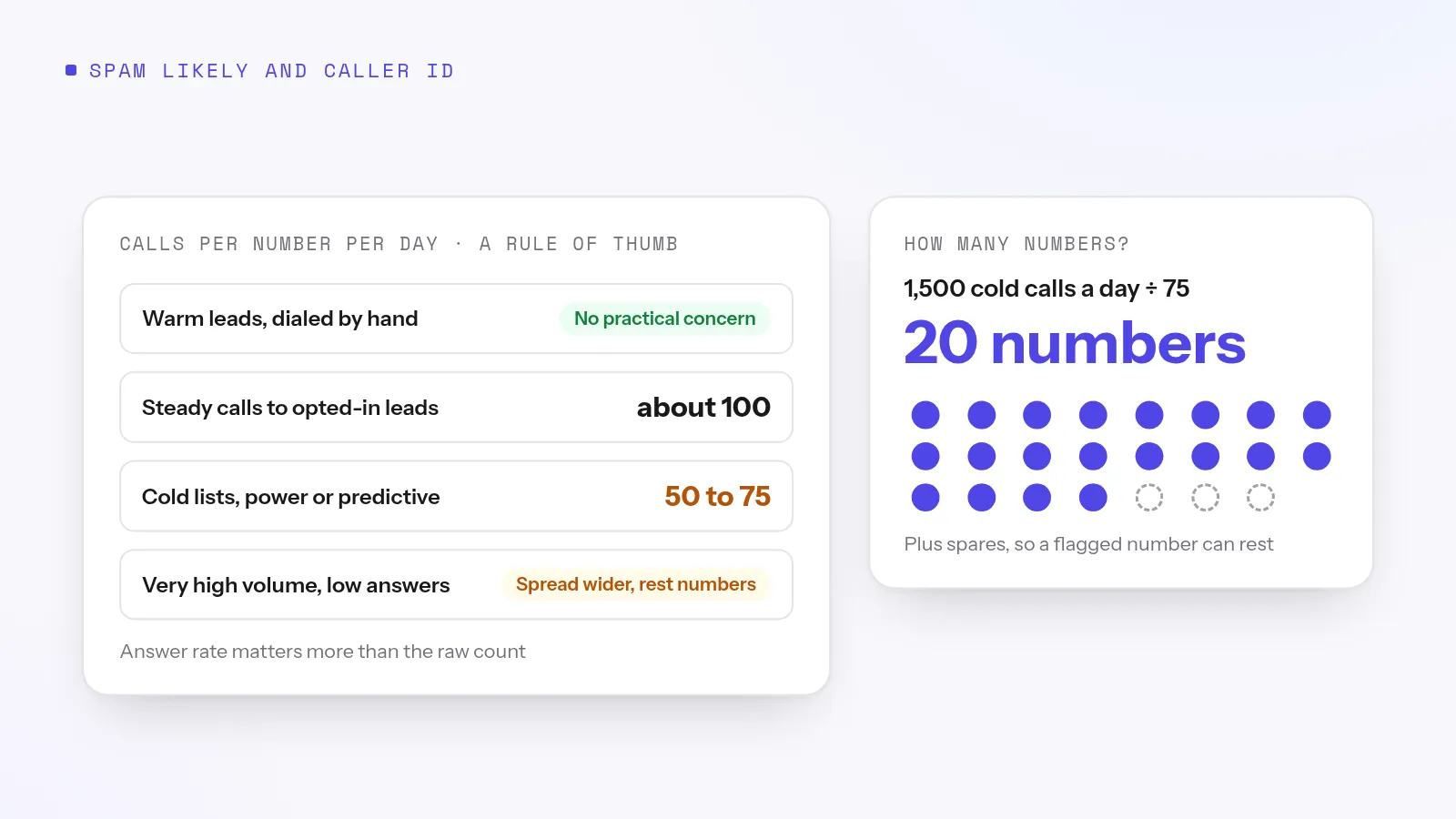
There's no official limit, and no number of calls guarantees a clean caller ID. Carriers and call-labeling apps judge a number by its pattern: how many calls it makes, how many are answered, how short they are and whether people complain. As a rule of thumb, many teams keep each number to around 50 to 100 outbound calls a day and add numbers rather than push one harder. Answer rate matters more than the raw count.
"How many calls can I make from one number?" is really a question about Spam Likely labels. This post is part of our guide to business caller ID.
Why volume gets numbers flagged
The analytics engines behind the big US networks don't publish their rules, but the signals are well known. A number that makes many calls, most of them short or unanswered, looks like a robocaller. Add complaints, or calls to numbers that were never in service, and the label follows. Two teams can make the same number of calls and get different results: one calling opted-in leads who pick up, the other cold-calling a stale list.
Rules of thumb by calling style
Calling style
Typical calls per number per day
Why
Rep calling their own warm leads by hand
No practical concern
Low volume, high answer rate, real conversations
Steady outbound to opted-in leads
Around 100
Answer rates stay healthy
Cold lists with power or predictive dialing
Around 50 to 75
Many short, unanswered calls per number
Very high volume, low answer rate
Spread wider, and rest numbers
The pattern itself is what gets labeled
These are starting points, not limits. Watch your own answer rate per number and adjust.
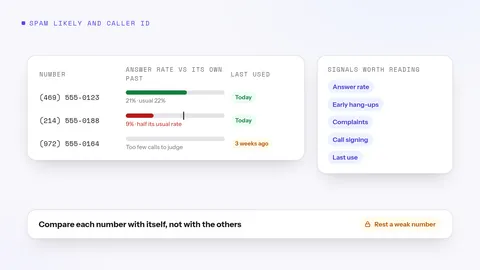
Spread heavy calling across a caller ID pool. Each number that's dialing gets a daily health score, and a flagged one rests on its own. Pools are in early access.
How many numbers do you need?
Divide the calls you plan to make each day by your per-number target, then add spares. A team dialing 1,500 cold calls a day at about 75 per number needs around 20 numbers in rotation, plus a few resting. Spares matter: when a number picks up a label, it can rest instead of dragging down the rest of the campaign.
What to watch, and what to do
Answer rate per number. A sudden drop on one number, with others steady, is the clearest early sign.
Very short calls. Lots of answered calls hung up within a few seconds suggests the label is showing.
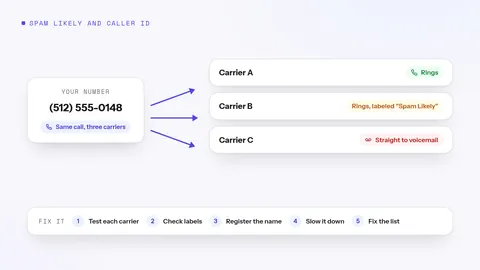
Test calls. Call your busiest numbers on the three big networks each week.
Attestation and registration. Make sure calls go out with good STIR/SHAKEN attestation and register your numbers with the free caller registry.
Every Adoptiv seat comes with its own US phone number, and you can add more; Adoptiv sells US numbers only. For heavy outbound calling, caller ID pools spread calls across several numbers. In a pool, each number that's dialing gets a daily health score from its answer rate and complaints, and a number that looks flagged rests for seven days on its own, and a spare takes its calls if the pool has one (caller ID reputation). Caller ID pools are in early access, so ask us if you'd like them turned on.
This is general information, not legal advice, so check with your own counsel.
Common questions
Is there a legal limit on calls per number?+
No federal rule caps calls per number. The limits that matter are carrier labeling and the rules on consent, calling hours and Do Not Call lists.
Does rotating numbers avoid Spam Likely?+
Spreading volume helps, but rotating to hide a bad pattern doesn't fix it. Clean lists and good answer rates matter most.
How long should a flagged number rest?+
A week is a common starting point. Test it again before putting it back into heavy rotation.
Do local numbers get flagged less?+
Not by themselves. Local numbers may get answered more, which helps, but the calling pattern still decides.
Adoptiv is the dialer, the CRM and the AI on one platform, where the busywork logs itself and your reps just talk. Try it free for 14 days, with no credit card.
Questions? Call +1 (844) 955-7733. SIYA answers and puts you through to a person.