Reading caller ID health: answer rate and last use per number
Adoptiv Team··Updated ·3 min read
Short answer
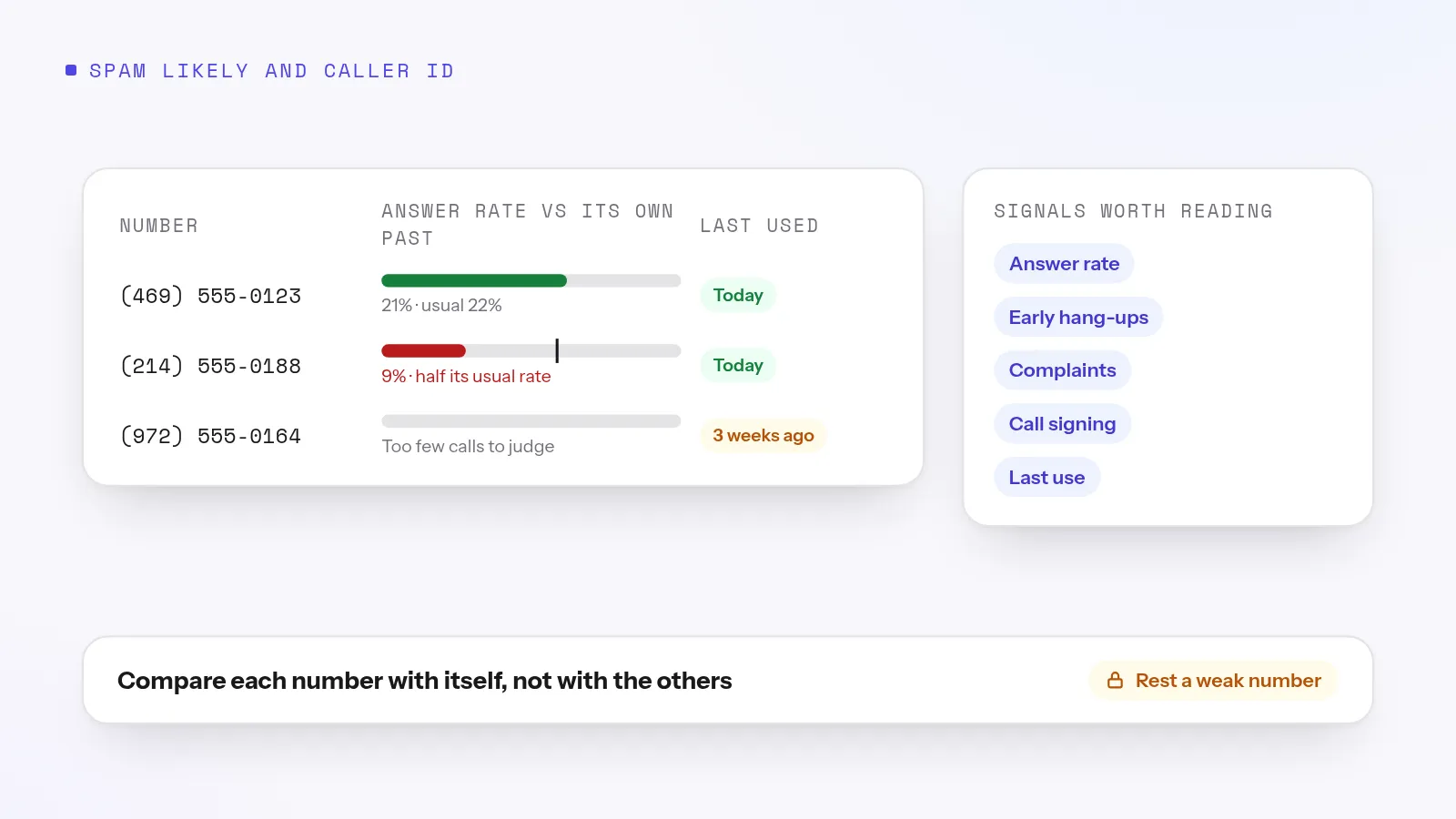
Read each number against its own past, not against your other numbers. A number whose answer rate suddenly halves, or whose answered calls mostly end within a few seconds, is probably being labeled. Complaints and weak call signing add to the risk. Check when each number was last used too: an idle number tells you nothing yet, and a number used far more than the rest wears out first.
When a team calls from several numbers, one bad number can hide inside a healthy average. Reading health number by number shows the problem early, often before reps feel it. This post is part of our guide to business caller ID.
The signals worth reading
Signal
What it tells you
Warning sign
Answer rate vs its own past
Whether people still pick up this number
A sudden drop, such as half its usual rate
Early hang-ups
People answer, see or hear something, and leave
Many answered calls ending within seconds
Complaints
Whether people are reporting the number
More than one in a month
Call signing (STIR/SHAKEN)
How strongly the network vouches for the caller ID
Calls signed below full attestation
Last use
Whether there's enough recent data to judge
Idle for weeks, or used far more than the rest
Compare a number with itself
A number calling a cold list will always answer less than one calling warm leads. That's why the most useful test is a number's recent answer rate against its own earlier weeks on similar lists. A sharp drop with no change in the list is the classic sign of a new spam label. Our post on what to do when your answer rate dropped walks through the causes.
Read early hang-ups carefully
When a phone shows "Spam Likely", some people still answer and hang up almost at once. A rising share of calls that end within a few seconds is often the first visible sign, but count only calls a person answered. Voicemail and machine pickups that the dialer hangs up on aren't hang-ups.
Get a daily 0 to 100 health score for each dialing pool number; flagged ones rest. Pools are in early access.
Why last use matters
Health signals need enough calls to mean anything. A number that hasn't been used for a while has no fresh data, so a clean-looking score may simply be old. At the other end, a number that carries far more calls than the others is the one most likely to get labeled. Check when each number last made calls, and spread volume so no single number does all the work. Our guide to caller ID rotation covers how.
What to do with a weak number
Take it out of rotation for a while, check its registration and caller name, and dispute any label through the carriers' registry. Then bring it back slowly and watch its answer rate. Our post on how to check if a number is flagged as spam has the step-by-step version.
Caller ID health in Adoptiv
Adoptiv's caller ID reputation check gives every dialing number in your caller ID pool a daily 0 to 100 health score, from signals that include its answer rate, early hang-ups and the complaints filed against it, plus how its calls are signed. Each number reads Clean or Watch with its score, or flagged. Its caller name and Free Caller Registry status are tracked alongside. Adoptiv runs its own check; it doesn't read carriers' labels.
Once a number has enough calls to judge, it's flagged when its answer rate halves or when 40% or more of calls a person answered end within six seconds. Two complaints in 30 days flag it at any volume. A flagged number rests for seven days automatically, and a spare takes its calls if the pool has one; a number flagged a third time is released and replaced. Smart caller ID suggests the best number in the manual call dialog. Caller ID pools are in early access.
Common questions
What is a caller ID health score?+
A single number that sums up how likely a caller ID is to be labeled or ignored, built from signals like answer rate, early hang-ups and complaints.
How many calls do you need to judge a number?+
Enough for a fair comparison with its own past, often a few dozen recent calls at least. A handful of calls can swing either way by chance.
Can a health score tell me if my number shows Spam Likely?+
Not directly. Carriers don't publish their labels. A health score catches the patterns that usually come with a label, so you can act early.
Should I stop using a number with a low score?+
Rest it rather than drop it: take it out of rotation, check its registration, and bring it back slowly while you watch its answer rate.
Adoptiv is the dialer, the CRM and the AI on one platform, where the busywork logs itself and your reps just talk. Try it free for 14 days, with no credit card.
Questions? Call +1 (844) 955-7733. SIYA answers and puts you through to a person.