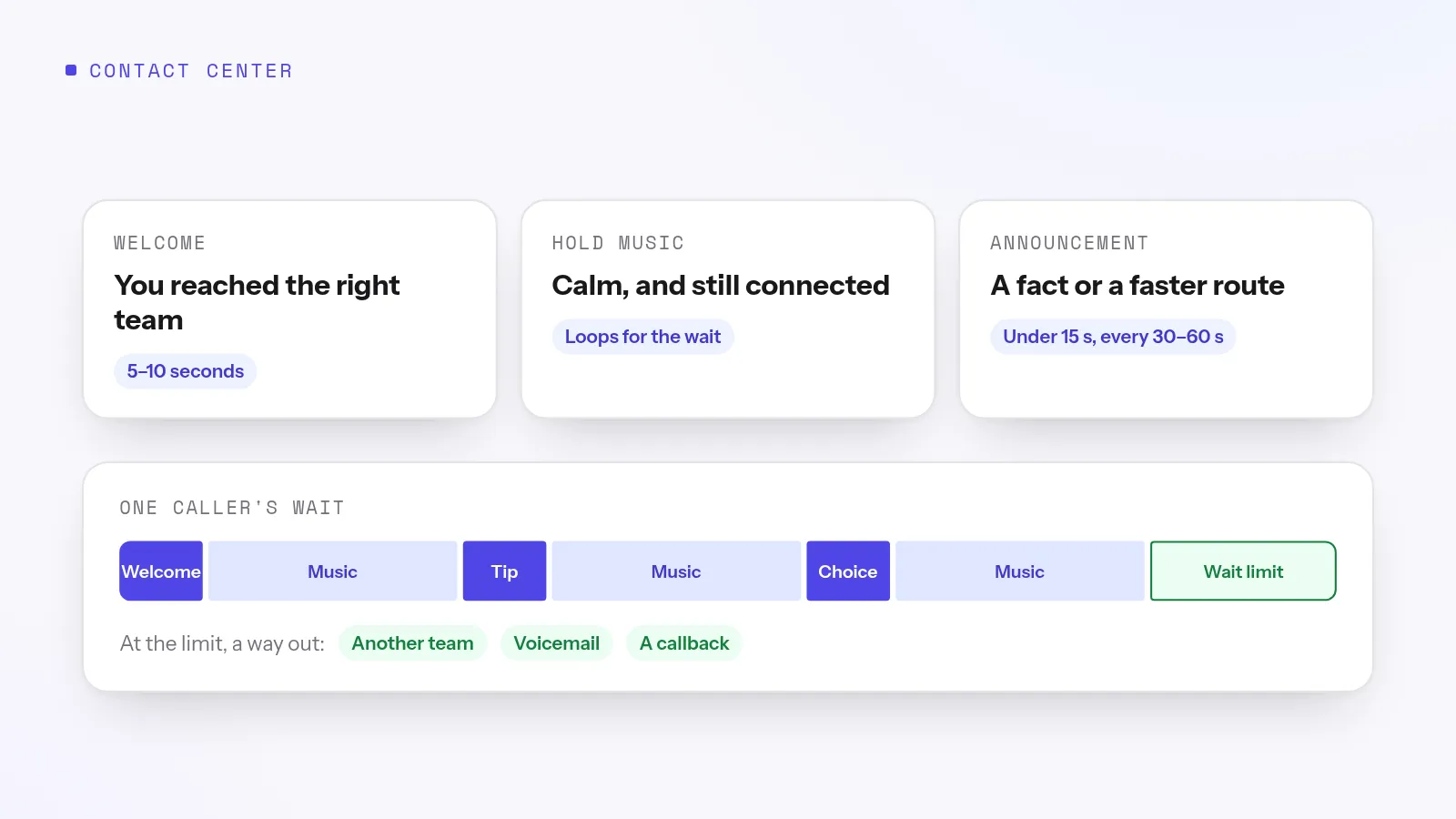
Callers in a queue should hear three things: a short welcome that says they reached the right place, calm music, and a brief announcement every 30 to 60 seconds that is actually useful. Keep each message under 15 seconds, never promise "your call is important" on repeat, and give long waits a way out instead of more music.
Playing a long brand message before every call, even when an agent is free
Hold music
Show the line is still connected
Loops for the wait
Loud, choppy tracks that sound like a dropped call
Announcement
Give a useful fact or a choice
Under 15 seconds, every 30–60 seconds
"Your call is important to us" every 20 seconds
Choosing hold music
Pick calm, steady tracks. Phone lines compress audio heavily. Soft piano or light acoustic music survives; heavy bass and sudden quiet passages sound like the call dropped.
Avoid silence. A silent line makes callers think they've been cut off, and many hang up within seconds.
Use music you're allowed to use. Popular songs need a license for business use. Royalty-free or licensed hold tracks avoid the problem. This is general information, not legal advice, so check with your own counsel.
Match the line. A sales line can sound upbeat; a support line for people with a problem should sound calm.
Try it on your own numbers. Give every queue its own hold music, a welcome and a timed announcement, and a wait limit that sends long waits on.
An announcement earns its place when it gives the caller something: a faster route, a fact they need, or a choice. A few examples:
"Thanks for holding. You can also reset your password any time at our website, under Account."
"If you're calling about today's storm damage, have your policy number ready to save time."
"Our team is helping other customers. Please stay on the line and the next available person will be with you."
Rotate two or three messages rather than repeating one. Callers who wait three minutes shouldn't hear the same sentence nine times.
When music isn't enough
No hold message fixes a wait that's too long. Set a wait limit, and decide where a caller goes when they reach it: another team, voicemail or a callback. Our post on overflow routing covers the options, and queue callbacks explains how letting callers hang up and keep their place works.
Hold music and announcements in Adoptiv
In Adoptiv's call queues, each queue can play its own hold music, and queues without one use your workspace default. You can upload your own track. The welcome can play always, only when nobody is free, or never, and a periodic announcement can play every so many seconds while callers wait. Queues don't announce a caller's position in line or an estimated wait. A queue's wait limit is 300 seconds by default. You place the queue in a call flow, which decides where a caller goes when the wait limit is reached.
Common questions
How often should a queue announcement play?+
Every 30 to 60 seconds is a good range. More often feels like nagging; less often and callers wonder if they've been forgotten.
Should the welcome message play when an agent is free?+
Usually not. If someone can answer right away, a long welcome only delays them. Play it only when the caller will have to wait.
Can I use any song as hold music?+
Not without a license. Popular music played to callers is a public performance; royalty-free or licensed tracks avoid that.
Should I tell callers their place in line?+
It helps when waits are short and predictable. When waits vary a lot, a callback offer usually works better than a number that keeps changing.
Adoptiv is the dialer, the CRM and the AI on one platform, where the busywork logs itself and your reps just talk. Try it free for 14 days, with no credit card.
Questions? Call +1 (844) 955-7733. SIYA answers and puts you through to a person.