Overflow routing: what to do when every agent is busy
Adoptiv Team··Updated ·3 min read
Short answer
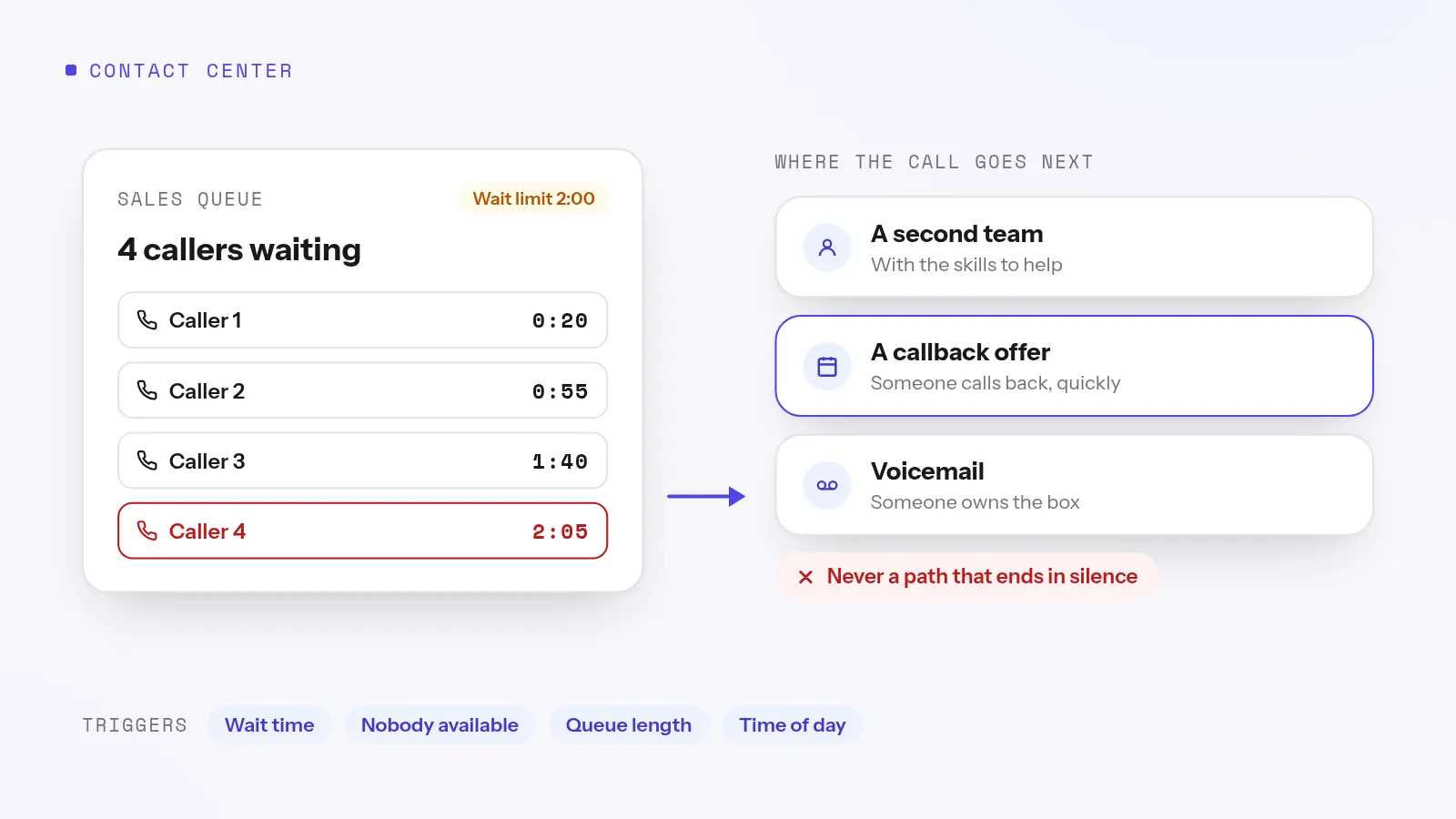
Overflow routing sends a call somewhere else when the queue can't take it: the wait has run too long, nobody is logged in, or the line is full. The usual destinations are a second team, a callback offer, voicemail, a self-service message or an outside answering service. Pick one trigger per situation, set a time limit, and make sure no path ends in silence.
Every phone team has an hour when calls arrive faster than people can answer them. Overflow routing decides what happens to the caller in that hour. This post is part of our guide to contact center software for small teams.
What triggers overflow
Overflow is a rule with a trigger and a destination. The common triggers are:
Wait time. The caller has waited longer than your limit, say two to five minutes.
Nobody available. Every agent is logged out, on a break or already on a call.
Queue length. There are already more callers waiting than you can reach in a reasonable time.
Time of day. The call arrives outside business hours, so the queue isn't the right place at all.
Wait time is the trigger almost every team needs. The others depend on how your system and your staffing work.
Where an overflowing call can go
Destination
Best for
Watch out for
A second team or queue
Sales overflowing to support, or a main site to a second site
The second team needs the skills and the context to help
Callback offer
Busy hours where the caller just wants an answer later
Someone has to actually call back, quickly
Voicemail
Small teams and after hours
Messages pile up unless someone owns the box
Self-service message
Common questions with a web answer
Frustrating if the caller needs a person
Answering service
Teams that can't miss a call
Cost per call, and the service knows less than your team
A callback is usually the kindest overflow for a busy hour, because the caller stops waiting and still keeps their request. We compare the options in queue callbacks and virtual hold.
Give every queue a wait limit and a way out. Draw where long waits go in the call flow, from a second team to voicemail.
Start with your average speed of answer and abandon rate by hour. If callers start hanging up around the two-minute mark, a five-minute wait limit is too long: most of them will be gone before overflow happens. Set the limit a little before the point where abandons climb.
Then check every path ends somewhere useful. A blank destination often means the call just hangs up, which is worse than a long wait. And keep overflow chains short: a caller passed from queue to queue to queue has a worse experience than one who waits a bit longer in the first one. If you're still choosing how calls reach agents in the first place, see call queue vs ring group.
Common mistakes
Overflowing to a team that's equally busy. Overflow to the sales line at 10 am when sales is also slammed just moves the wait.
No owner for the voicemail box. A box nobody checks is a hang-up with extra steps.
One limit all day. A wait that's fine at 3 pm may lose half your callers at 10 am.
Forgetting after hours. Calls outside your hours should skip the queue and go straight to the after-hours path.
Overflow in Adoptiv
Each call queue in Adoptiv has a wait limit, 300 seconds by default. In the call flow, the Queue step has a timeout path, so when the wait runs out the call goes wherever you drew it: a voicemail box for the company, a team or a rep, another queue, or another flow. Business hours are set per call flow, so after-hours calls can skip the queue entirely.
Common questions
What is call overflow?+
Call overflow is when a queue gets more calls than its agents can answer in time. Overflow routing is the rule that moves those calls somewhere else.
How long should callers wait before overflow?+
A little less than the point where abandons start rising for your line. For many teams that's somewhere between one and three minutes.
Is voicemail a good overflow destination?+
For small teams, yes, as long as someone owns the box and calls back the same day.
What's the difference between overflow and a callback?+
A callback is one kind of overflow: the caller leaves the queue and your team calls them back later.
Adoptiv is the dialer, the CRM and the AI on one platform, where the busywork logs itself and your reps just talk. Try it free for 14 days, with no credit card.
Questions? Call +1 (844) 955-7733. SIYA answers and puts you through to a person.