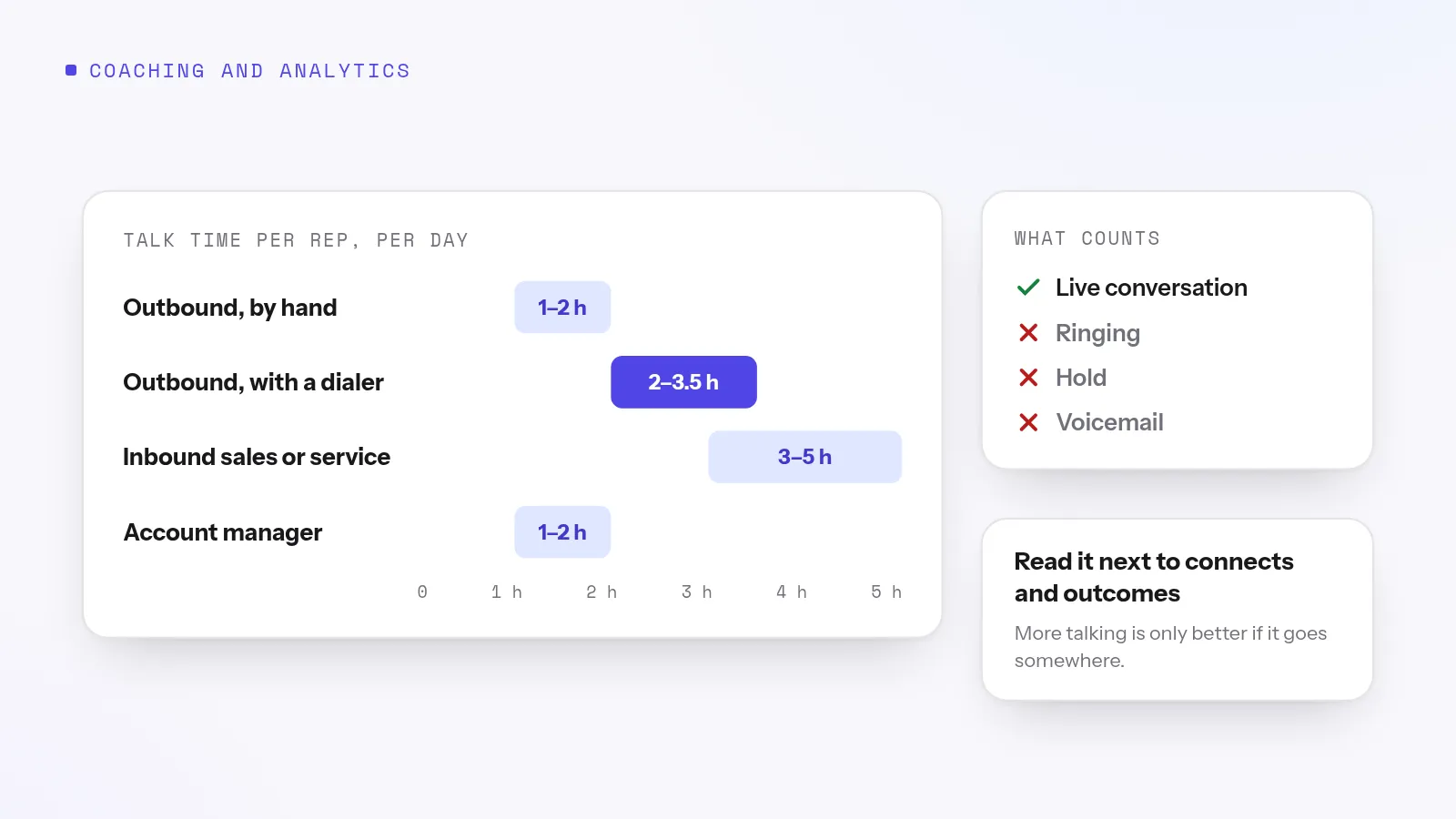
Talk time per rep is the total time each rep spends in live conversations over a period, not counting ringing, hold or voicemail. For full-time outbound reps, two to three hours of talk time a day is a healthy range; inbound reps depend on call volume. Read it next to connects and outcomes, because more talking is only better if the talking goes somewhere.
Talk time is one of the simplest call figures to count and one of the easiest to misread. This guide covers what it measures, where a fair range sits and how to use it in coaching. It's part of our call center metrics and coaching guide.
What talk time measures
Talk time starts when the other person is on the line and ends when the call does. Ringing, the phone menu, hold and voicemail aren't conversation, so a fair count leaves them out. Two related figures are often confused with it:
Average talk time per call is talk time divided by conversations. It tells you how long a typical call lasts.
Handle time adds hold and the notes after the call. Our guide to average handle time covers that one.
Talk time per rep is the total, so it grows with both the number of conversations and their length.
What a fair range looks like
Role
Typical talk time per day
What drives it
Outbound SDR, manual dialing
1 to 2 hours
Dials per hour and how often people answer
Outbound rep with a dialer
2 to 3.5 hours
Less time dialing and waiting, more live answers
Inbound sales or service
3 to 5 hours
Call volume and staffing, not the rep
Account manager
1 to 2 hours
Meetings and email take the rest of the day
These are planning figures, not targets. A team with a small, warm list will talk less than a team working a large cold list, and that's fine. Our post on how many cold calls a rep can make per hour shows how the dialing method changes the ceiling.
Try it on your own numbers. See how long each rep spends talking, counted from the calls themselves, on a dashboard your team shares.
Long calls that go nowhere. A rep who spends 40 minutes with one friendly prospect who will never buy has great talk time and a bad day.
Short calls that do the job. A rep who books a meeting in four minutes looks weak on talk time and strong on results.
Volume outside the rep's control. On inbound lines, talk time mostly tracks how many calls came in.
A rep who talks the whole time. Total talk time can't tell you whether the customer got a word in. Listen to a few calls for that.
That's why talk time belongs next to connects and outcomes. Our post on contact rate vs connect rate covers the two counts that sit in front of it.
Using talk time in coaching
Compare a rep to themselves first. A drop from three hours to one hour for the same rep on the same list is worth a question. A gap between two reps on different lists usually isn't.
Look at the shape, not just the total. Many short calls can mean a weak opener. A few very long ones can mean a rep who doesn't ask for the next step.
Pair it with an outcome. Talk time per meeting booked, or per sale, says more than talk time alone.
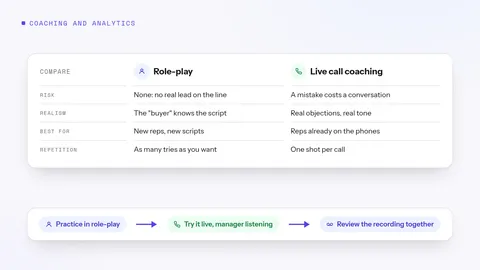
Listen to the extremes. The longest and shortest calls of the week are the quickest way into a coaching conversation. Our sales call coaching guide has a routine for it.
Talk time in Adoptiv
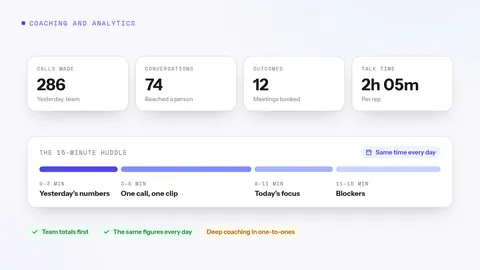
Every call lands on the contact by itself, with who called whom, when, how long it ran, the outcome and the recording, through automatic call logging. Talk time per rep is counted from those call records, with hold and the phone menu left out, and you can put it on a dashboard next to the outcomes it should lead to, shared by team or role. While calls are in progress, the live calls board shows how long each one has run. Admins see every call. A manager sees the people on the teams they manage and the people who report to them, and needs the "Supervise calls" permission to listen in, whisper or barge in. Everyone else sees their own calls.
Common questions
Is more talk time always better?+
No. More talk time is good when it comes with more connects and better outcomes. On its own, it can reward long calls that go nowhere.
Does hold time count as talk time?+
It shouldn't. Hold, ringing and the phone menu aren't conversation, so a fair count leaves them out. Handle time is the figure that includes hold and the notes after the call.
How much talk time should an SDR have per day?+
About one to two hours when dialing by hand, and two to three and a half with a dialer. Your list and how often it answers matter more than any benchmark.
Should talk time be a target?+
Use it as a signal rather than a quota. A target on talk time teaches reps to stretch calls. A target on outcomes, read alongside talk time, doesn't.
Adoptiv is the dialer, the CRM and the AI on one platform, where the busywork logs itself and your reps just talk. Try it free for 14 days, with no credit card.
Questions? Call +1 (844) 955-7733. SIYA answers and puts you through to a person.