Average handle time (AHT) is the average time an agent spends on one call from start to finish: talk time, plus hold time, plus the after-call work of notes and follow-ups, divided by the number of calls handled. It tells you how much agent time each call really costs. Bring it down by cutting hold time and after-call typing, not by rushing the conversation.
AHT is one of the oldest call center numbers, and one of the easiest to misuse. Here's how to calculate it, how to read it, and how to improve it without hurting the calls themselves. This post is part of our call center metrics and coaching guide.
The formula
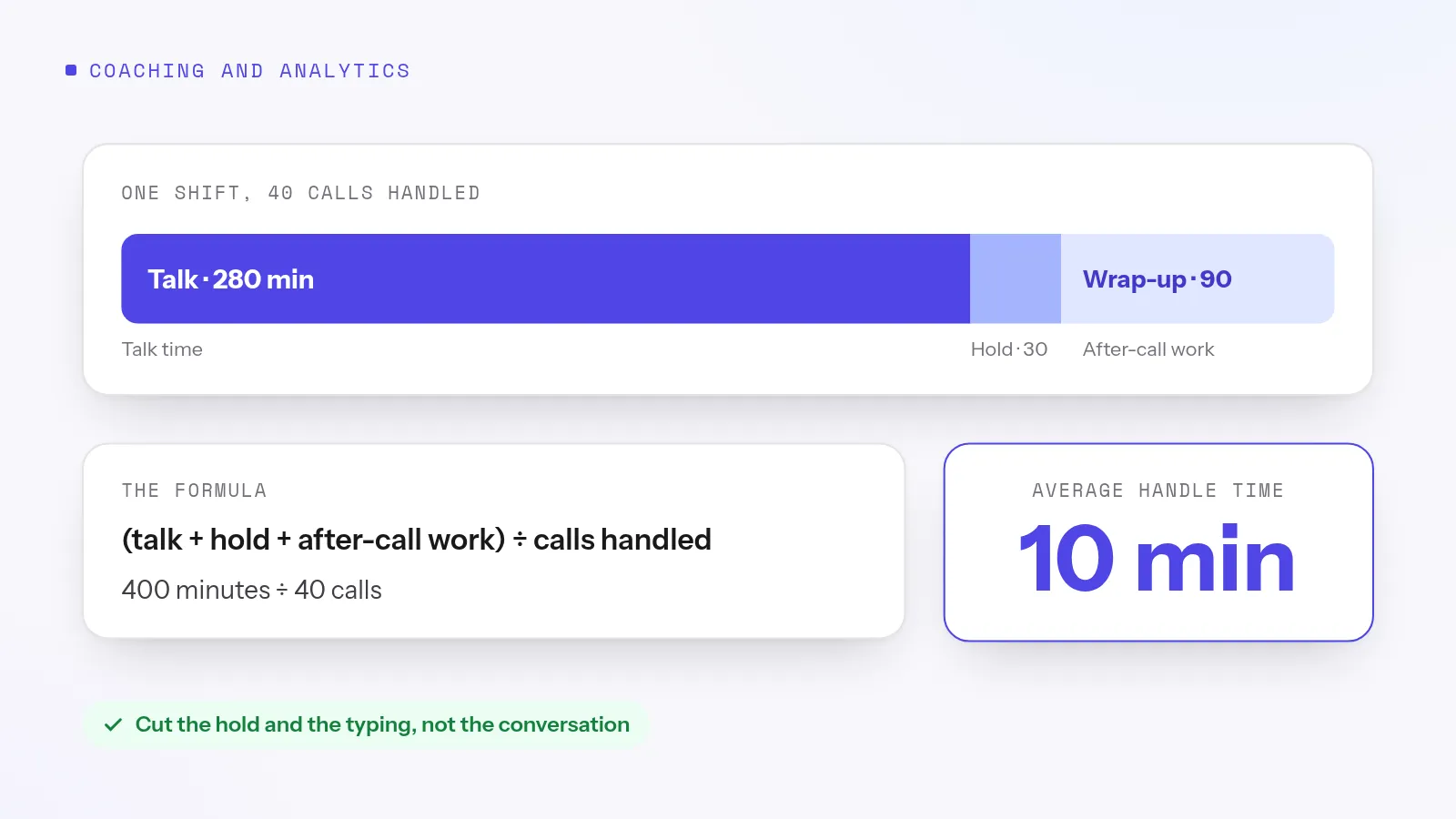
AHT = (total talk time + total hold time + total after-call work) ÷ calls handled
Say an agent handled 40 calls in a shift, with 280 minutes of talk, 30 minutes of hold and 90 minutes of after-call work. That's 400 minutes over 40 calls, or an AHT of 10 minutes. Count only calls an agent actually handled. Abandoned calls and calls that never reached a person belong in other metrics.
What each part tells you
Part
What drives it up
What usually fixes it
Talk time
Complex calls, unclear scripts, agents searching for answers mid-call
Better call guides, coaching on the opening and the close
Hold time
Looking things up in another system, asking a colleague
Customer details on screen when the call starts, clear escalation paths
After-call work
Typing notes, logging the call, setting follow-ups
Calls logged automatically, written summaries, fewer required fields
Let recorded calls write their own summary, so wrap-up takes seconds. Included on AI+ and Dialer Plus.
There's no universal target. A password reset and a mortgage protection quote can't share one number, and neither can inbound support and outbound sales. Set separate baselines for each call type or queue, and compare agents only within the same kind of work. A sales rep with a long AHT and a high close rate is doing the job, not failing it.
AHT also trades against other metrics. Push it too hard and first-call resolution falls, callbacks rise, and customers wait longer overall. Read it next to the numbers in outbound call center metrics, and next to average speed of answer on the inbound side.
How to reduce AHT without rushing calls
Cut after-call work first. It's usually the largest slice that adds nothing for the customer. Logging calls automatically and writing summaries for agents can take minutes off every call.
Remove hold time. If agents put callers on hold to look something up, get that information onto the screen when the call starts.
Coach the long tail. Listen to the longest 10% of calls each week. They usually point to one missing answer or one confusing step.
Don't set a hard cap. Agents who are timed to the second end calls early and push the work onto a second call. Our guide to sales call coaching covers better ways to change behavior.
Where Adoptiv fits
Most of what Adoptiv does for handle time is in the after-call slice. Calls, voicemails and texts land on the lead's history by themselves, so nobody logs a call by hand. On AI+ and Dialer Plus, call summaries are included for calls on the rep's own number: after each recorded call or voicemail above the minimum length you set, a summary of one to six sentences is written on the record. For inbound teams, each call queue carries a service-level target, 60 seconds by default.
Common questions
How do you calculate average handle time?+
Add up talk time, hold time and after-call work for all handled calls, then divide by the number of calls handled.
Does AHT include hold time?+
Yes. Hold time is part of the agent's time on the call, so it counts, along with talk time and after-call work.
What is a good average handle time?+
It depends on the call type. Set a baseline for each queue or kind of call and track the trend, rather than chasing an industry number.
Is a lower AHT always better?+
No. Cutting it by rushing customers usually raises repeat calls and lowers resolution. Cut hold time and after-call work first.
Adoptiv is the dialer, the CRM and the AI on one platform, where the busywork logs itself and your reps just talk. Try it free for 14 days, with no credit card.
Questions? Call +1 (844) 955-7733. SIYA answers and puts you through to a person.