Auto dialer vs power dialer: what's the difference?
Adoptiv Team··Updated ·3 min read
Short answer
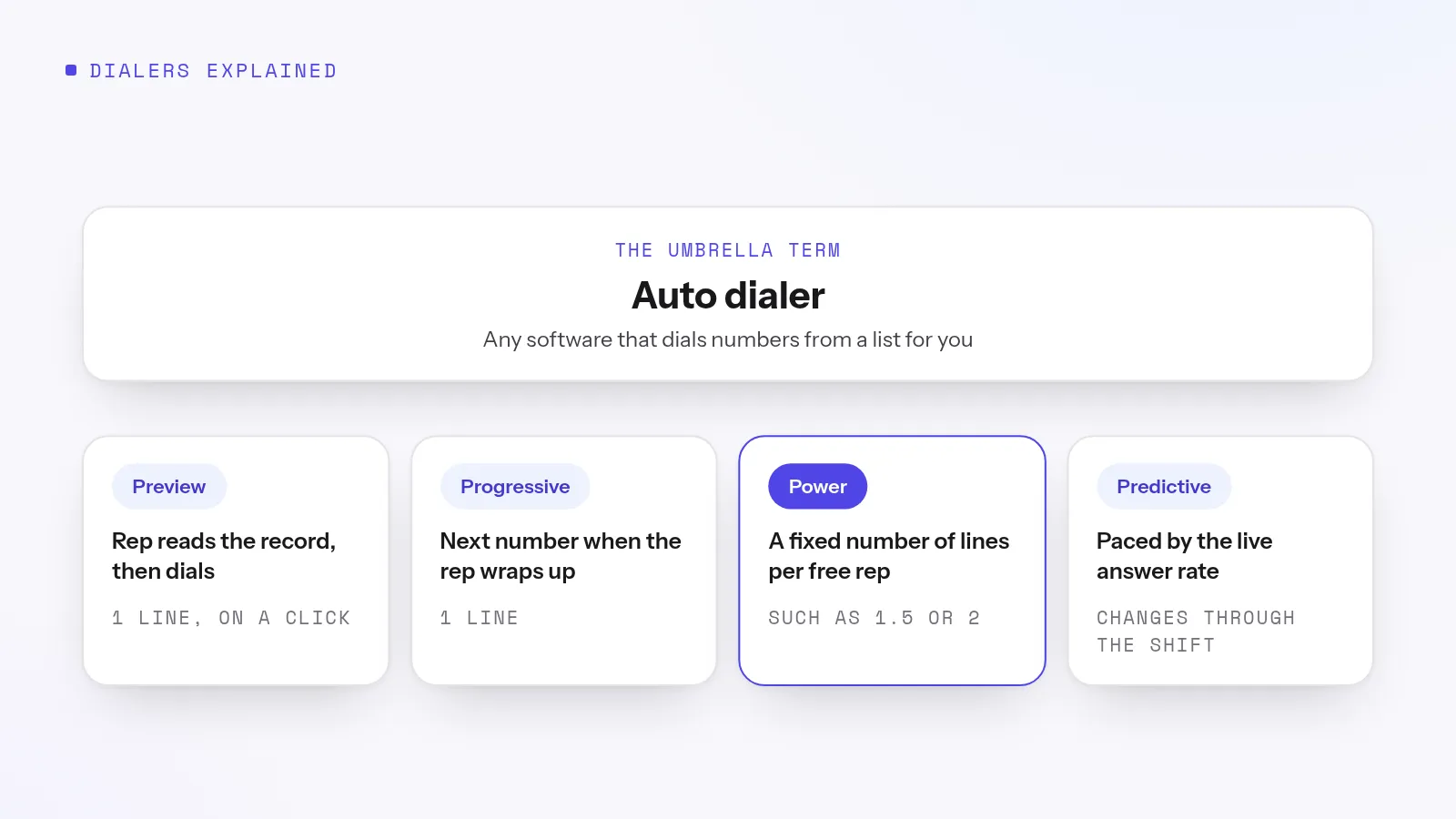
"Auto dialer" is the umbrella term for any software that dials numbers from a list for you. A power dialer is one kind of auto dialer: it dials a set number of lines for each free rep. The other common kinds are progressive (one line after each call), predictive (lines paced by how often the list answers) and preview (the rep reads the record before the call).
Vendors use "auto dialer" to mean different things, which makes comparing tools harder than it should be. Here are the four modes you'll see across the industry, and which one suits which list. Part of our outbound dialer guide.
The four dialing modes compared
Mode
How it dials
Lines per free rep
Risk of dropped calls
Best for
Preview
Opens the record before the call
1
None
Key accounts, renewals, callbacks
Progressive
Dials the next number when the rep wraps up
1
None
Small teams and steady lists
Power
Dials a fixed number of lines per free rep
A set number, such as 2 or 3
Some, depending on the setting
Long lists where most calls go unanswered
Predictive
Adjusts its pace from the live answer rate
Changes through the shift
Kept under a limit you set
Larger floors and big lists
So is a power dialer an auto dialer?
Yes. Every power dialer is an auto dialer, but not every auto dialer is a power dialer. When a vendor says "auto dialer", ask which modes it means. Some mean predictive only, some mean power only, and some use the term for tools that play recorded messages.
That last meaning matters. Calls that play a prerecorded message, and calls dialed automatically to mobiles, are covered by specific consent and calling rules in the US. Those rules vary by call type and state. This is general information, not legal advice, so check with your own counsel.
Power vs predictive
Power dialing opens the number of lines you choose for each free rep, every time. Predictive dialing changes that number through the shift, dialing more when the list answers well and less as dropped calls approach your limit. Predictive needs enough reps on the phone at once for its pacing to work, usually around eight or more. Below that, power or progressive is usually the better fit. For the detail, see what a power dialer is, how predictive dialing works and our guide to predictive vs power dialers.
Campaigns are in early access. Ask us to run preview, power or predictive dialing on your own list.
And parallel dialers?
A parallel dialer is a power dialer for one person: it rings several numbers at once for a single rep. We cover the trade-offs, and why some teams avoid it, in power dialer vs parallel dialer.
Picking a mode
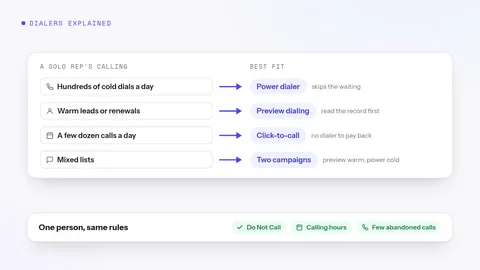
Fewer than 5 reps, warm leads: preview or progressive.
5 to 20 reps, long cold lists: power, at a modest setting.
8 or more reps on the phone at once: predictive.
Mixed lists: run different modes on different campaigns.
How Adoptiv does it
Campaigns in Adoptiv are in early access. Each campaign runs one of three modes, chosen when you create it: preview, power or predictive. There is no progressive mode. Preview dialing opens the record before the call; by default a 5-second countdown then starts it, and the countdown can be lengthened or switched off. Power dialing opens 1 to 5 lines for each free rep. The predictive dialer paces itself from your answer rate and keeps dropped calls under the limit you set for the campaign.
A campaign keeps the mode it was created with. To change pace, run a second campaign in another mode and move reps between them between calls. By default, a power or predictive campaign calls a lead only if it has a Do Not Call screening from the last 30 days; a preview campaign shows such a lead to the rep with a warning, and the rep can call only after giving a reason. A lead on your own do-not-call list, or a known litigator, is never called in any mode. On power and predictive campaigns, answering machine detection keeps voicemail greetings away from reps. Preview dialing works on every plan; power and predictive need Dialer Plus or Enterprise. Adoptiv has no parallel dialer where one rep watches several lines ring, but power mode can dial several lines for each free rep.
Common questions
Is a predictive dialer an auto dialer?+
Yes. Predictive is one mode of auto dialing, alongside power, progressive and preview.
Which dialing mode never drops a call?+
Preview and progressive. Each dials one line for a rep who is already free, so the rep is there when someone answers.
Can I switch modes mid-shift?+
Not within one Adoptiv campaign: the mode is fixed when the campaign is created. Run campaigns in different modes and move reps between them between calls.
How many reps do I need for a power dialer?+
Even one rep can use power dialing at a low setting. It pays off most for teams of about five to twenty working long lists.
Adoptiv is the dialer, the CRM and the AI on one platform, where the busywork logs itself and your reps just talk. Try it free for 14 days, with no credit card.
Questions? Call +1 (844) 955-7733. SIYA answers and puts you through to a person.