Voicemail transcription turns each message into text, and voicemail to email sends new messages, often with that text, to the right inbox. Together they let a team read and sort messages in seconds instead of listening to each one. Check three things before relying on them: who gets each box's email, what happens when transcription fails, and who answers the message.
A voicemail nobody hears is a missed call twice. This guide covers how transcription and voicemail to email work for a business, and how to set them up so every message reaches someone who acts on it. It's part of our contact center software guide.
How voicemail transcription works
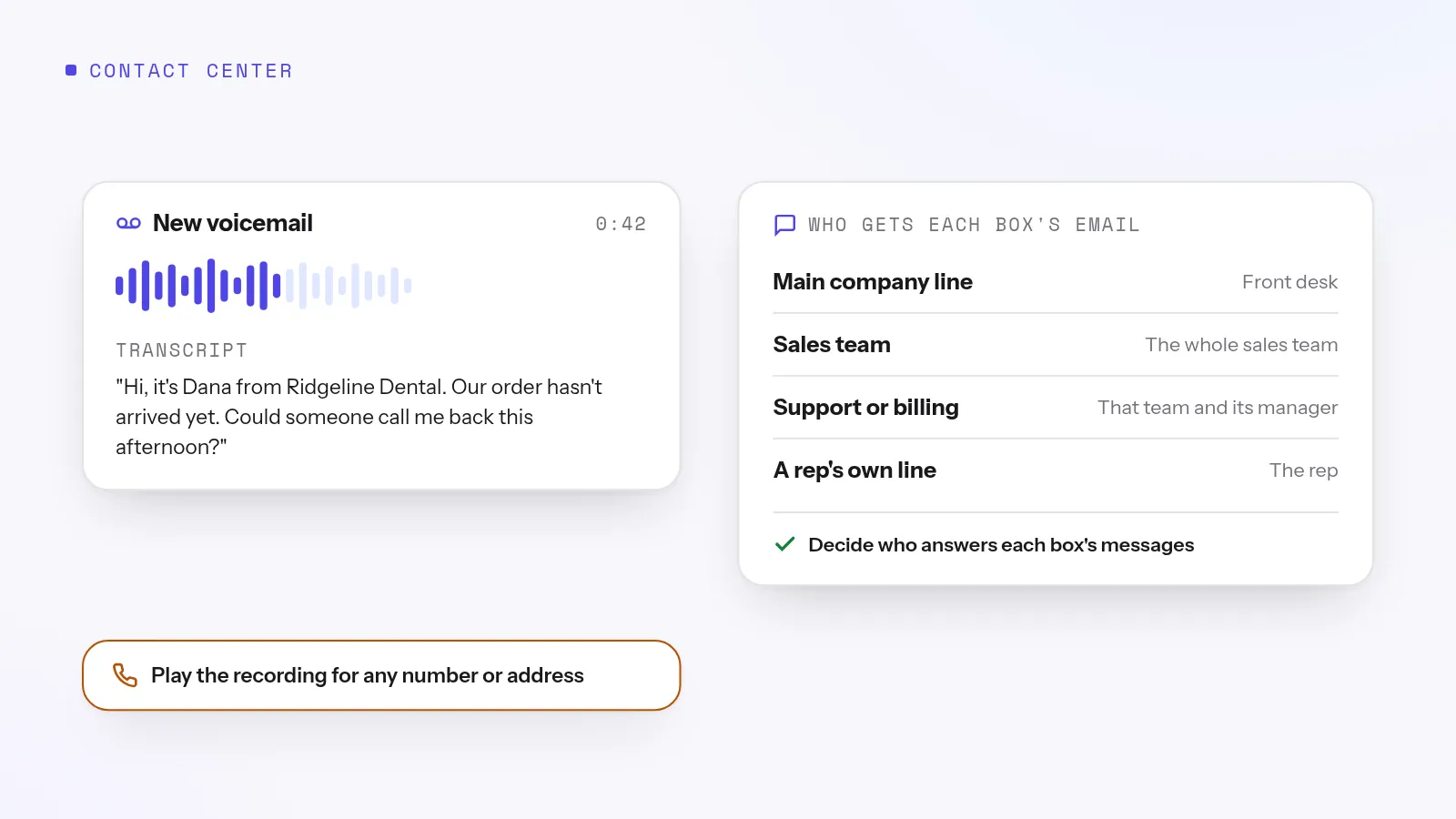
When a caller leaves a message, the recording is sent to a speech-to-text engine, which returns the words. Good transcription gets names of streets and products wrong sometimes and numbers right most of the time, so treat the text as a fast preview, not a record. The recording stays the source of truth.
Strong at: what the call is about, whether it's urgent, a callback number spoken clearly.
Weak at: unusual names, heavy background noise, people who mumble or speak very fast.
Searchable: once messages are text, you can find "refund" or a street name across a week of messages.
Voicemail to email: who should get what
Box
Who should get the email
Who answers
Main company line
The office manager or front desk
Whoever is on duty that morning
Sales team
The whole sales team
The first rep to claim it
Support or billing
That team and its manager
By rota
A rep's own line
The rep
The rep, with the manager as backup
The rule is simple: every box has a named owner who checks it first thing. Shared boxes need a way to say "I've got this one" so two people don't call back the same customer. Our guide to after-hours call handling covers which calls should reach voicemail at all.
Try it on your own numbers. Give every team its own voicemail box, with new messages by email and transcripts you can search.
Emails to a leaver. Update box owners when people change roles.
Transcripts read, recordings ignored. Play the recording for anything with a number or an address.
A missing transcript means a missing email. If your setup only emails once the transcript is ready, a failed transcription can mean no email. Check the voicemail list itself every day too.
Holiday gaps. Messages left over a long weekend pile up. Plan who works through them; our post on holiday call routing helps.
Voicemail in Adoptiv
Adoptiv has four kinds of voicemail box: organization, team, role and personal, and who can listen depends on the kind of box. Each box can email new messages. Voicemails are transcribed automatically or on request, and the transcripts are searchable. Transcription is part of AI call analysis. On AI+, Dialer Plus and Enterprise it's included for voicemails left on a rep's own number; other voicemails, such as those to a company line, are paid from your prepaid wallet. Each box sets a message length from 10 seconds to 10 minutes, nothing is deleted automatically, and there are no text-message alerts. Pair boxes with business hours so after-hours calls land in the right one.
Common questions
How accurate is voicemail transcription?+
Accurate enough to tell what a message is about and how urgent it is. Names, addresses and numbers are worth checking against the recording before you act on them.
Can a team share one voicemail box?+
Yes, and it's the best setup for sales or support lines. Give the box a named owner and a way for one person to claim each message.
Is voicemail to email secure?+
The email goes to whoever the box is set to notify, so keep that list current. Limit who can download recordings to the people who need the file.
Should I still listen to voicemails if they're transcribed?+
For anything you'll act on, yes. Read the transcript to sort messages, then play the recording for the details.
Adoptiv is the dialer, the CRM and the AI on one platform, where the busywork logs itself and your reps just talk. Try it free for 14 days, with no credit card.
Questions? Call +1 (844) 955-7733. SIYA answers and puts you through to a person.