Skills-based routing: how it works and when a small team needs it
Adoptiv Team··Updated ·3 min read
Short answer
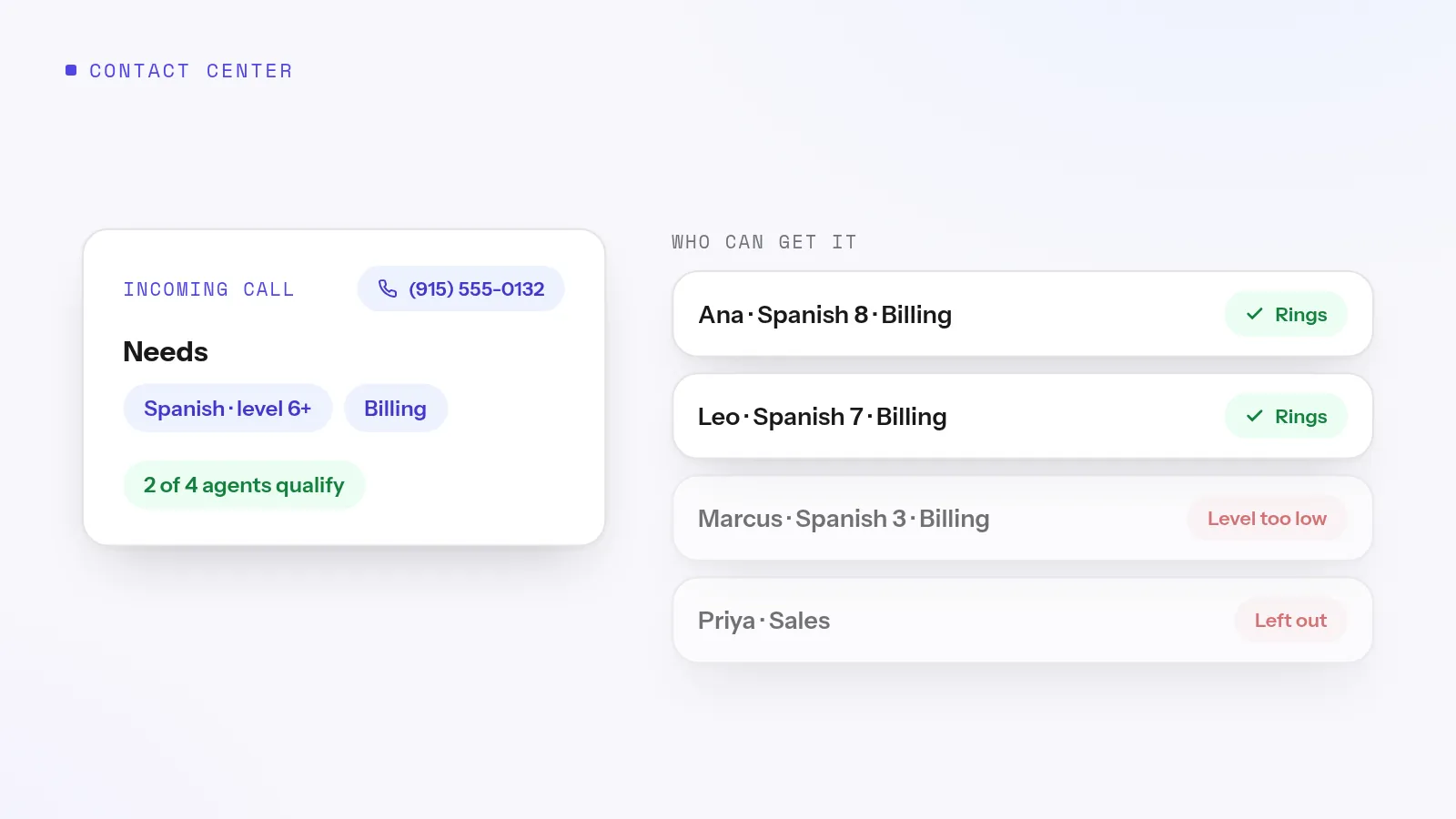
Skills-based routing sends a call only to agents who have the skill it needs, such as a language, a product or a license, at the level it needs. Everyone else is left out before a phone rings. A small team needs it once not everyone can handle every call. Until then, a simple queue with a fair ring strategy is enough.
On a team where everyone can take every call, routing only has to decide whose turn it is. Add a Spanish-speaking caller, a tier-2 technical question or a client account only three people are trained on, and "whoever is free" stops working. The call gets answered, then transferred, and the caller explains everything twice. Skills-based routing fixes that by deciding who is allowed to answer before anyone does. It's part of our contact center software guide for small teams.
How it works
Name your skills. Anything that splits your calls: a language, a product line, a license, a client account.
Rate each agent. Give agents a level for each skill they hold, not just yes or no, so a new hire can be a 4 and a specialist a 9.
Set what each queue needs. List the skills its calls require, the minimum level, and whether agents must have all of them or any one.
Plan for gaps. Decide where a call goes when nobody can take it, so it isn't simply dropped.
One point people often miss: skills filter, they don't sort. Once the list is cut to the agents who qualify, your ring strategy still decides who rings first.
Skills-based routing vs round robin
Round robin alone
Skills-based routing
Who can get the call
Anyone in the queue
Only agents with the skill, at the level required
A call nobody can handle
Answered, then transferred
Sent to a backup before anyone answers
Workload
Shared evenly across everyone
Shared evenly among those who qualify
Setup
None
Skills, levels and queue rules to keep up to date
They aren't rivals. Most teams that use skills keep round robin, or another strategy, to share calls among the agents who qualify.
Send every caller to someone who can actually help. Skills and levels decide who may answer each queue's calls.
Too many skills. Every skill you add makes the pool for some calls smaller. Start with the two or three that really split your calls.
Levels nobody updates. A rep who has improved in six months should be rated that way. Review levels each quarter.
No backup route. A specialty with one trained person is a dead end when they're on lunch. Always set where those calls go instead.
Trying to tag callers. Most systems attach skill needs to the queue, not the caller. Sort callers into the right queue first, usually with a menu key such as "para español, oprima dos."
How Adoptiv does it
Adoptiv's skills-based routing lets you name any skill and give each agent a level from 1 to 10. Each queue lists the skills its calls need, a minimum level for each, and whether agents must match all or any. When a queue must match all of its skills, an agent with no level for one of them never gets the call. When it can match any, one qualifying skill is enough.
If no agent on the queue holds a required skill at all, the call leaves the queue instead of waiting, so wire that exit in your call flow to a specialist queue or a voicemail box. A qualified agent who is busy or away still counts, so the caller waits for them up to the queue's wait limit. To take a skill away from an agent, remove it, and add it back when they're ready. Among the agents who qualify, the queue's ring strategy decides who rings first.
Common questions
What is skills-based routing?+
A way of routing calls so they only ring agents who have the skills the call needs, at the level it needs.
Can I route calls by language?+
Yes. Make the language a skill, send those callers to their own queue from a menu, and require the skill on that queue.
Does skills-based routing decide who rings first?+
No. It decides who may answer. The ring strategy decides the order among the agents who qualify.
What happens if nobody has the right skill?+
The call should go to a backup you choose. In Adoptiv, a call that no agent on the queue is skilled for leaves the queue at once, so wire that exit in the call flow to a specialist queue or voicemail.
Adoptiv is the dialer, the CRM and the AI on one platform, where the busywork logs itself and your reps just talk. Try it free for 14 days, with no credit card.
Questions? Call +1 (844) 955-7733. SIYA answers and puts you through to a person.