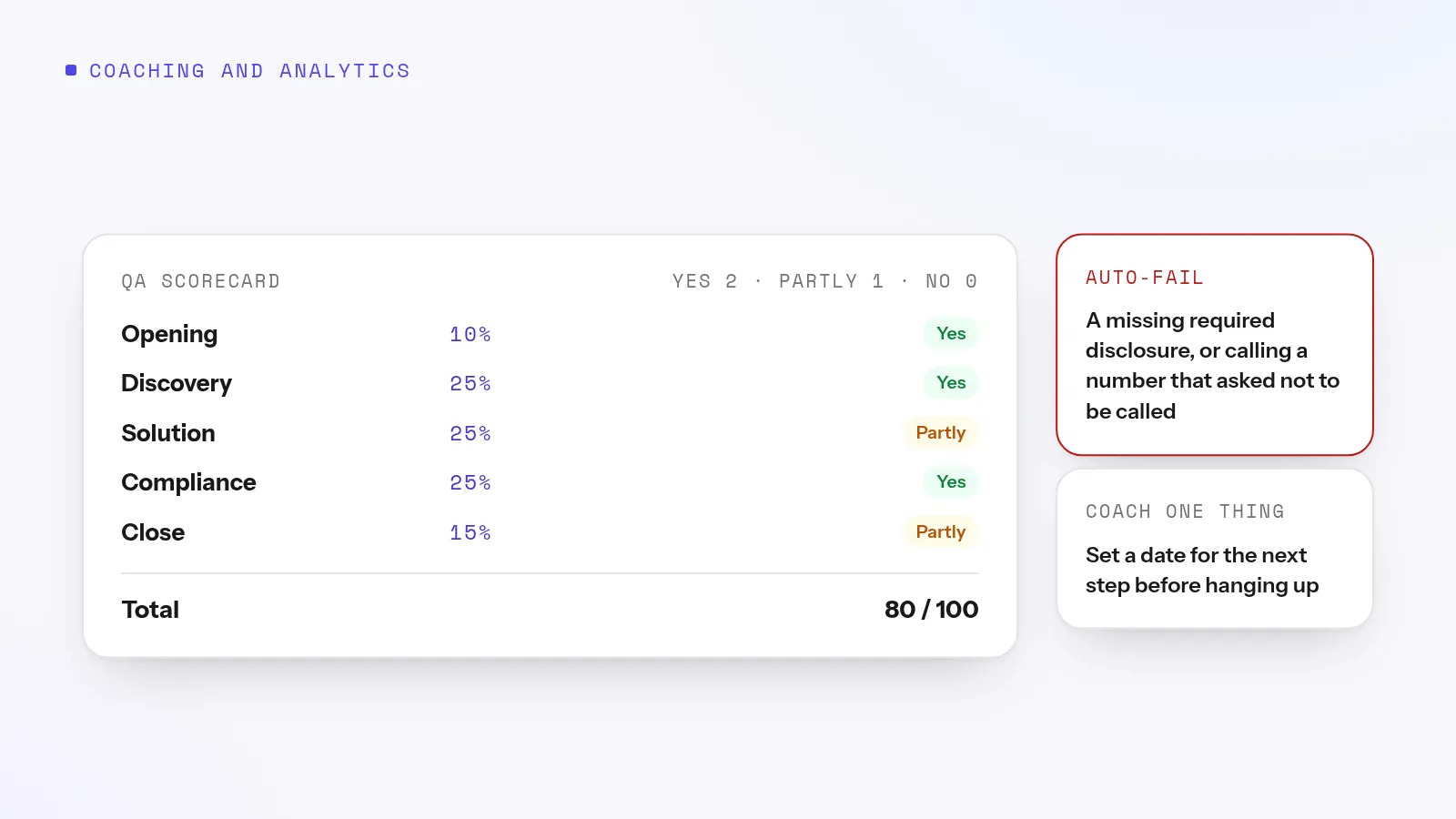
A good QA scorecard has five weighted sections (opening, discovery, solution, compliance and close), a short list of auto-fail items, and room for one note on what to coach. Score each line yes, partly or no rather than on a 1–10 feel, total it to 100, and calibrate with your reviewers every month so the same call gets the same score.
Copy this, then change the lines to fit your calls. Score each line 2 (yes), 1 (partly) or 0 (no), and multiply by the section weight.
Section
Weight
What to check
Opening
10%
Greets and names the company; confirms who they're speaking to; states the reason for the call
Discovery
25%
Asks open questions; confirms the need in the caller's words; doesn't interrupt
Solution
25%
Gives a correct answer or offer; explains next steps; checks the caller understood
Compliance
25%
Required disclosures given; consent and opt-out requests handled; nothing promised that can't be kept
Close
15%
Summarizes what was agreed; sets a date for the next step; logs the outcome and notes
Weights are a starting point. A support team might move weight from discovery to solution; a collections team will want compliance higher.
Auto-fail items
Some mistakes outweigh a good call. List them separately, and a call that hits one fails whatever its total: a missing required disclosure, calling a number that asked not to be called, sharing account details before verifying identity, or a false promise about price or terms. Keep the list short, or reviewers stop trusting it. Which disclosures and consent steps your calls need depends on your industry and states. This is general information, not legal advice, so check with your own counsel.
Try it on your own numbers. On AI+, Dialer Plus and Enterprise, analyzed calls get five scores from 0 to 10, so you know which to review first.
Define every line. "Confirms the need" should say what counts, with one example of a yes and one of a no.
Calibrate monthly. Have every reviewer score the same three calls, compare, and settle the lines where they differ.
Sample fairly. Pick calls across days, times and outcomes, not only the ones a manager heard about.
Coach one thing. End each review with the single change that would lift the next call most.
Use the scores, not just collect them
Look at each section across a rep's calls, not only the total. A rep at 80 overall with a weak close needs different coaching from one at 80 with weak discovery. Tie the scorecard to an outcome you already track, such as first call resolution, so you can see whether better scores mean better results. For running the sessions themselves, see sales call coaching.
Where AI scoring fits in Adoptiv
Reviewing calls by hand only covers a sample. On AI+, Dialer Plus and Enterprise, call analysis is included for calls on each rep's own number, and analysis of other calls is paid from your wallet. Adoptiv's call scoring gives each analyzed call five scores from 0 to 10: communication, issue resolution, customer satisfaction, compliance, and an overall judged on its own rather than averaged. Compliance scoring uses no fixed list of required phrases, and you can add your own context about your scripts, which SIYA reads as background to every analyzed call. Automatic analysis runs on calls with at least 30 seconds of talk (60 seconds outbound). Use the scores to choose which calls get a full scorecard review. More in AI call scoring.
Common questions
What should a call center QA scorecard include?+
Sections for opening, discovery, solution, compliance and close, each with clear lines, a weight, a short auto-fail list and space for one coaching note.
How many calls should QA review per agent?+
Many teams review four to eight calls per agent a month. Fewer than that and one bad day can skew the picture.
What is a good QA score?+
On a 100-point card, 85 or above is a common target, but the trend matters more than the number. Calibrate before comparing teams.
What is QA calibration?+
Reviewers score the same calls separately, then compare and agree on the lines where they differ, so one reviewer's 80 matches another's.
Adoptiv is the dialer, the CRM and the AI on one platform, where the busywork logs itself and your reps just talk. Try it free for 14 days, with no credit card.
Questions? Call +1 (844) 955-7733. SIYA answers and puts you through to a person.