Business call recording: what to record, how long to keep it, and how to use it
Adoptiv Team··Updated ·3 min read
Short answer
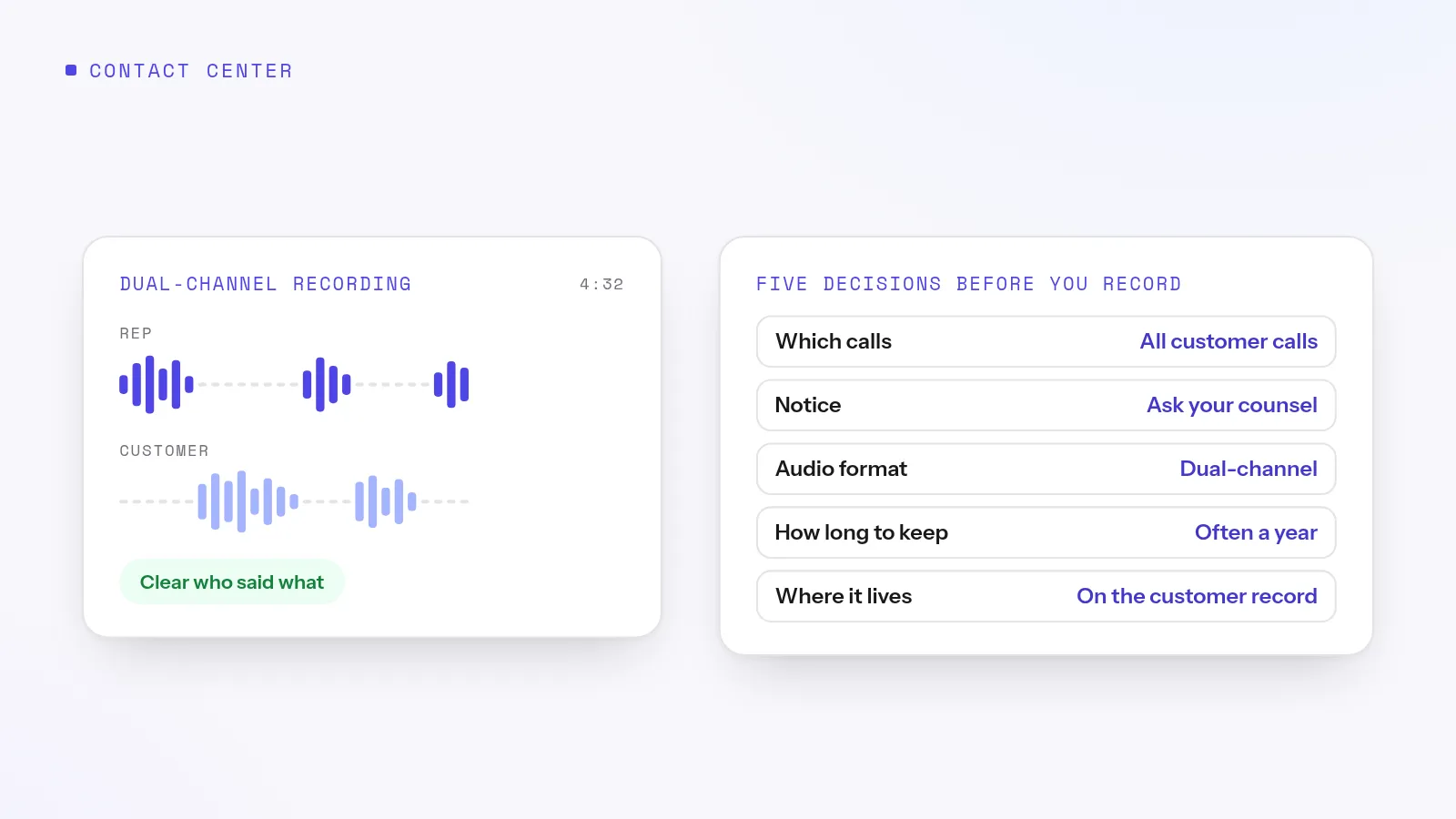
Record every customer call, give notice where your calls need it, and keep recordings long enough to cover disputes and coaching, often a year. Choose dual-channel recording, which puts your rep and the customer on separate channels, so it's clear who said what. Then use the recordings: listen to the calls that matter, settle disputes from the audio, and let transcripts and summaries do the rest.
Most phone systems can record calls. The difference is whether those recordings are any use when you need them, and whether anyone can find the right one. This post is part of our contact center software guide for small teams.
Five decisions to make before you record
Decision
Options
Our suggestion
Which calls
All, outbound only, or picked by rep
All customer calls. Partial recording misses the disputed call.
Notice
Greeting message, rep script, or none
Follow your counsel's advice for the states you call
Audio format
Single track (mono) or dual-channel (stereo)
Dual-channel
How long to keep
30 days to several years
Long enough to cover disputes and refunds. A year suits most sales teams.
Where it lives
A separate recorder or on the customer record
On the customer record, next to the call
Notice and consent
In the US, some states let one party to a call consent to recording, and others expect everyone on the call to agree. If you call across state lines, the simplest approach is a short notice at the start of every call, either in your greeting or as the first line of the rep's script. This is general information, not legal advice, so check with your own counsel.
Record your first calls today. Every seat includes recordings kept for a year, with your rep and the customer on separate channels in one file on the call record.
A mono recording mixes both voices into one track. When people talk over each other, or a customer later says "your rep promised X", you're left guessing from the wording. Dual-channel recording keeps each side on its own channel, so who said a line is clear from the audio itself. It also makes transcripts more accurate, because each channel is transcribed separately and every line is labeled with the right speaker.
How to use recordings (without listening to all of them)
Disputes: find the call, skip to the moment, play it to the customer or the rep.
Coaching: pick a few calls per rep each week. Negative and very long calls are good places to start.
New hires: build a short playlist of great calls and send it to every new rep.
Day to day: read the summary instead of replaying the audio. Our post on transcripts vs summaries covers which to read when.
How Adoptiv does it
Call recording in Adoptiv captures your rep and the customer on separate channels and merges them into one stereo file on the call. The recording follows the customer's side, so transfers (see warm vs cold transfers), device switches and three-way calls stay in one file. Every seat includes recordings kept for a year. Each recording is capped at two hours by default, and you can play it, scrub through it or download it from the call record. You find calls by number, call ID or contact name. Transcript text isn't searchable.
Adoptiv plays no beep or recording announcement to either side. If your calls need a notice, add it to your greeting or have reps say it. On AI+ and Dialer Plus, calls on your own number get a transcript split by speaker, with a toggle to swap the labels if they come out reversed. Very short calls are skipped: it takes at least 30 seconds of talk (60 seconds on outbound calls), and admins can set a higher minimum. AI call analysis adds a summary, sentiment, tone, intent and scores, included on those plans for calls on your own number.
Common questions
How long should a business keep call recordings?+
It depends on your industry and the disputes you face. Many sales teams keep a year. Some regulated industries keep longer, so check what applies to you.
Do I have to tell customers a call is recorded?+
In some states everyone on the call must agree. A notice at the start of every call is the simple approach. Ask your counsel.
What is dual-channel call recording?+
Recording each side of the call on its own channel, then storing both in one stereo file, so each voice stays separate.
Does a transfer start a new recording?+
In Adoptiv, no. The whole conversation stays in one file, through transfers and three-way calls.
Adoptiv is the dialer, the CRM and the AI on one platform, where the busywork logs itself and your reps just talk. Try it free for 14 days, with no credit card.
Questions? Call +1 (844) 955-7733. SIYA answers and puts you through to a person.
Adoptiv Team. “Business call recording: what to record, how long to keep it, and how to use it”. Adoptiv Inc, November 18, 2026. Retrieved from https://adoptiv.com/blog/business-call-recording